(Nov 16) What are you building this week?
What are you building at work or on the side? Drop a link if it's public!
One thoughtful comment that is not AI-assisted unlocks the ability to create threads.
363 comments
Also I think thumbs up/down are not working properly (or nobody liked anything ?) I currently only see my own votes
So the design of this forum is a bit different than traditional upvote / downvote forums like Reddit.
I’m using a decision model to grade every thread / comment and that accounts for 100% of the ranking in the beginning. Then over time as more people view the comment more and more of the score weighting shifts to upvotes / downvotes.
This gives more incentive to comment on older threads (since a high quality comment will still get sent to the top immediately), and improves ranking overall (LLM judge is a more sane default than waiting for a few people to scroll to the bottom of a long comment thread or look at the “New” feed).
Will tweak this a bit over time, I'm also working on an About page atm that will explain this a bit more clearly!
Okay, that's extremely interesting! Would love to read and understand which decision model you selected and how you configured it.
That's the first live example of a decision model I am witnessing :)
You should see what the game industry is up to... if there's one good GenAI application in there (because players hate it for creative uses), it's the use of decision models for player sentiment and reactive behavior/state
-> I modded a popular anime game exploring AI use to test Liquid AI's d1 model when that first dropped, and with a splash of game design work... well, let's say it's a lot more engaging when the characters have a sense of emotion based on personality and game state, and react to + remember things you've said or done!
This is great! I could also see it being useful to add a couple profiles to the AI judges allowing you to choose a default comment arrangement experience so that you could choose for example mild or spicy or more technology focused, etc. upon your profile setup and change any time. And also I always come back to the idea of a persisted local database that keeps all of your context between all of your different various LLM’s allowing you to share your contacts between them in your own authority that one day you can even default it to whatever someone context is already set to.
That's a clever approach to forum thread comment visibility and voting. Reminds me of when the search engines were reading meta tags to produce results, and then Google Beta saunters up and goes "a site that's linked to from a lot of other sites is probably a good resource and should be listed higher in the results." A good solution seems like the most obvious thing once it's put into words.
I recognize that this reply doesn't add any substance to the conversation -- I'm posting primarily to test forum functionality as I didn't immediately notice a Testing area.
Speaking of, would it be worth adding a Testing area for those of us looking to throw stuff at the wall without cluttering up useful discussions?
Interesting idea, we may have a permanent "Test post, please ignore" somewhere! Actually rn there's a hidden thread I use for automated testing.
Polite UI Request: I'd like to be able to collapse replies, so I can easily read the next comment at the level I'm at. I need this feature to stop myself going down rabbit holes, or to not get sucked into arguments. On the other hand, it means I'll completely ignore whole chunks of the conversation, so if you want the philosophy here to be everyone reads everything, this will make things worse.
Right now you can currently jump to the next / previous comment using the j / k keys and jump to the next / previous top level comment using shift + j /k, does that solve for this or would you still want to collapse?
My brain says that j should go back (up) and k should go forward (down), but that's perhaps just me. If space bar could collapse the current comment tree that would be perfect
Collapsing is now live, it maps to the enter key so enter collapses the current comment tree. j being down and k being up is the standard Vim key binding, shift + j/k now jumps to the next comment at the same level rather than the next top level comment!
This is a clever way to solve the cold-start problem. One subtle issue though: the model's initial ranking also determines which comments get enough exposure to collect votes, so the eventual human signal isn't entirely independent of the judge.
Have you considered reserving a bit of randomized exposure to measure whether the model's quality judgments actually correlate with reader preferences?
Hey Dan! Amazing start. Please consider letting participants indicate why they upvoted someone else's contribution/idea/project/etc. How: add an option to indicate which larger AIM it helps them achieve. Advantage: Knowing these themes would give us all a finger on the pulse of what's possible and valuable. Specifics: Allow freestyle answers. Use your tools to suss out possible connections between the many projects going on. Examples: My first post was about 'getting agents to behave'. I bet others are facing the same challenges. I'd like to learn with them. Another Advantage: clicking on AIMs or OUTCOMEs would let me see immediately relevant conversations. I could learn faster from someone else's experience, or possibly share an idea that could help them.
I haven't checked all the comments possibly making this repetitive, so apologies in advance. From what little I understand about the spirit of this endeavour, we wanna circulate the best ideas so we bubble them up to the top. But the current UX shows you all the sub threads from top, making it so that even the 2nd idea after your comment(the fusion one) is a few too many scrolls down to catch my eye. Perhaps we wanna collapse the sub threads with an optional toggle so all the top ideas aren't hard to find? Maybe eventually you might wanna pin the interesting sub-comments, but that can come later. Or did I misunderstand the vision?
Awesome! Works like a charm! I'm amazed by how responsive you are.
This definitely makes thing easier, but not exactly what I had in mind for the experience. I tried looking up Reddit, LessWrong etc but they don't use what I had in mind either. Perhaps ig comments are closer to it, where the default landing behavior is that the main comment is open, but all sub comments are closed under a "view replies" button. This way the user gets to have a BFS lay of the land before diving into a node. But given how the comments here can be much longer than ig(and also nested), not sure if this just works out of the box. I feel like the comments should have a fixed real estate(of my attention), i.e in this case the height they consume. With "view more" and "view replies" buttons, fading the comment and top reply out in a gradient thus teasing out the rest. Here's a visualization from Gemini(using this comment as the prompt) that sorta shows what I mean. Perhaps you can ask others Fixed width bfs comment experience (sites.google.com)
Hey really sorry not sure how I missed this! The visual is super helpful, what you're proposing is actually quite similar to how x.com currently works, with a hard cutoff so comments all take up roughly the same visual height.
Let me think a bit more about the implications of this for long form conversation, my intuition is that it would nudge people to leave shorter comments by default which I'm not sure is the desired outcome (but maybe culturally it would shift people to leading with a hook like on X?).
If I post something, it doesn't get posted the first time. Although posting the same thing second time works fine for me.
When I edit an existing comment, the cursor starts at the beginning of the text. I’d prefer it to start at the end so I can pick up where I left off.
Also the keyboard navigation is great. One suggestion will be to have an option for pressing R on the comments which could take me to the reply mode for now. Links, images can be built later.
I get that this isn't Reddit and don't want to offend the good work your doing, but one UX feature of Reddit that I really like is comment/reply collapsing. Tapping the parent most comment will collapse all its children's replys. I prefer clicking over scrolling, but that just my personal preference.
Added to my Home Screen as a PWA. Feels pretty good so far! Is there a repo to contribute to for this?
I like the appearance, I just wish there was more ways to sort the comments though like date for example
Yeah if it could be reversed if you tapped it twice too, so you can check the oldest to monitor history and then revert back to newest to see what people are commenting that's new.
Scrolling to the bottom takes a long time, so a quick inversion option would be cool.
Just signed up. Thanks for the invitation. It would be nice if we had the option to modify our usernames. Just food for thought. Looking forward to being part of the community.
@PaulMant now works, it also autocompletes member names!
Building an AI powered digital tutor for high school and college students with ADHD to save them from the mediocrity and complexity of LMS systems like Canvas.
Been working on this for about 9 months now. Solo project and company made entirely possible by Claude Code. Most fun I’ve had in years. Psyched to have one school already piloting it and dozens of students using it daily.
As a adjunct college instructor who uses Canvas, I upvote the mediocrity comment. In fact, the entire infrastructure of "bulletin board" teaching is dated and probably does more harm than good.
I teach mathematics at the college level and I haven't found any university or college infrastructure yet that does it "right". Right now, online learning is a bunch of mindless bulletin board questions like "where would you use a parabola in your daily life?" that are now just being answered by chatbots or copied mindlessly out of the textbook.
The online teaching model needs a severe re-engineering effort.
Love this idea. To me the biggest benefit AI has brought us is access to unlimited learning for anyone. I built an online learning platform to help people learn any topic and give them structure to keep with the topic over time. Shared with friends and family but was nervous to take the leap to a real business. It's a free version right now and I cover the token and cloud costs myself.
I'm teaching AI agents to run sophisticated simulations of nuclear fusion devices called tokamaks. Running simulations is not difficult, so an agent can figure it out by reading documentation and source code, but tokamaks are complex, and very often to achieve precise simulation a physicist or AI physicist needs to generate and test many hypotheses. AI can do this very well, but in many cases, it is not enough to have only one agent. Instead, I build chains of agents that generate hypotheses, review and prioritize them, independently estimate their impact, and so on.
Woah! This reminds me of when I was at CERN, it seems a lot like the AI models the particle physicists are working with there, not just to simulate collisions but also filter petabytes per second down to MB/GB in multiple stages.
One big challenge they always face is the mix of "filter the right data out of it to train on", "get all the inputs and outputs right", and "cross-check the most valuable outputs (human)"... is it the same battle? Do your experiments test real-time control / temporal constraint hypotheses too?
The timescale of tokamak plasma processes is 10^-5 s, so we have enormous data processing problems too, but so far I have mostly focused on validating our simulator (old scientific code, Fortran + Python) against the experimental data.
Ahh, makes sense! When you say "validating", are the hypotheses generated like proper hard-math / logic, or behavioral, both, or neither i.e. just oracle cross-check to make it go "yep good enough"? Given how chaotic the mystical models of the underlying EM/plasma equations seem, I'd imagine some blend of tree exploration in that...
(and if you need someone to pick brains or assist w/ what I'm guessing would be high-vol stream processing btw, lmk! That stuff is super fun to crack at the bottom end, know some folks too 🍻)
This is super cool! Are you finding AI helpful in reducing the cost of running simulations too or primary for generating hypotheses?
This contraption. Long story short: a manual footage counter for textile that a loom produces. I needed a way to verify that MES production data was accurate, and didn't want to sink hours of CAD work into the issue.
The coolest part of this project is...
On Monday I gave Claude a picture of a handrail on where I wanted this device.
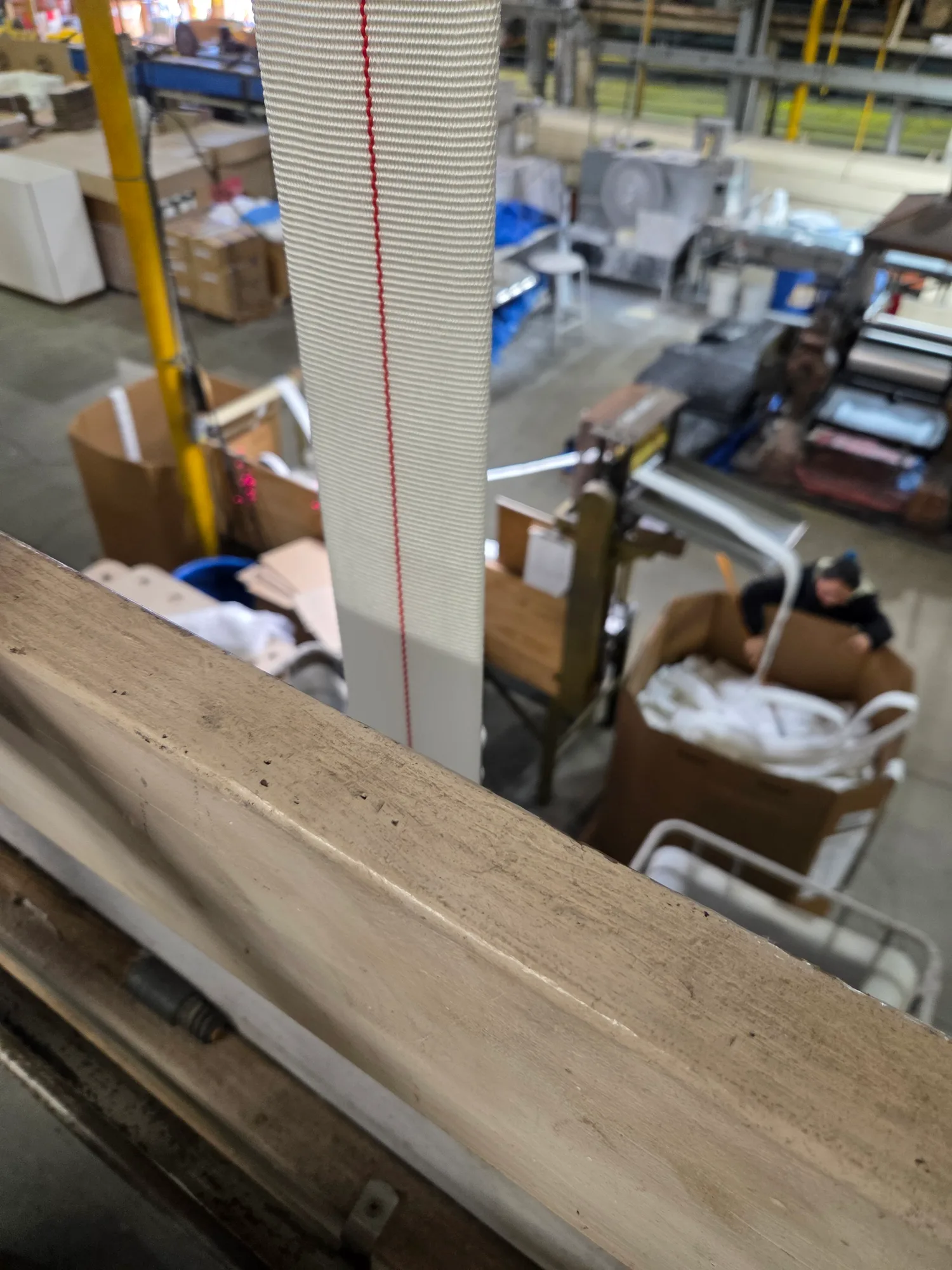
Then spent about 2 hours conversating about design intent, constraints, and deliverables. Fable 5.2 thought/worked for 45 minutes and then delivered: -6 x CAD files (.step), complete with a .3mf print plate for each -A McMaster Carr buy list for hardware needed (bearings, shafts, etc) -An assembly guide artifact with step by step instructions on how to build
I just YOLO sent it over to my Bambu 3d printer, and bought the hardware.
Spent 2 hours building it as per the guide. There was some trivial improvements that I had to do, and other parts that it missed to put on the buy list, but I did not need to reprint anything.
It works and is used to calibrate all our digital footage counters.
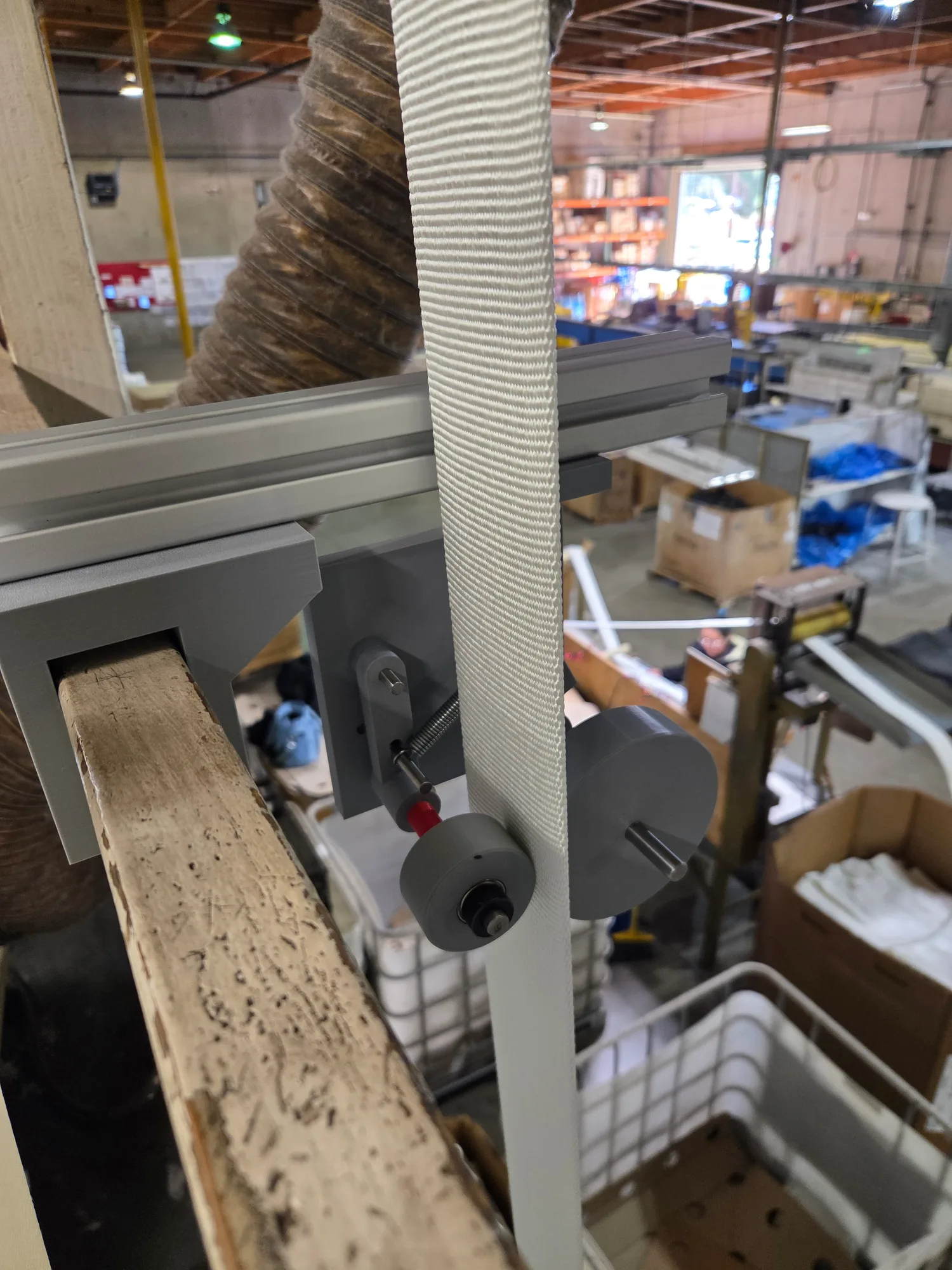
I guess this is the definition of just asking AI for a todo list and blindly doing it lol
(note: this was more of me evaluating where AI is currently at. One-shot blind build a physical device. Really cool!)
I'm working on TLDR Reader (kingfisher.tldr.fm), a place for fresh tech news.
Feel free to browse or search (you can use queries of arbitrary length). You can make one-off searches or use them to tune your feed. The stories are expandable, so that you can get the most important information about a story without clicking through. We want it to feel like a TLDR newsletter, but more customizable and even fresher.
All comments welcome! As with this forum, everything from bug reports to interface details would be great to hear about. I'll be watching this thread closely.
Hi Nate - I built an app that can index a newsletter and have users chat with a chatbot that answers grounded in the context of that newsletter. It's here: https://github.com/drLIyer/Pulsebot and I am also working on building a plugin that can be added by users in Claude.ai. Do you want to connect?
AudioMaster.ai (not sponsored, just my pet project)
This has been eating my spare time for a few years now. I spent 2017 and onward working as an audio engineer with dozens of different artists. And the whole way through, there was this huge hole in the industry that kept bothering me: nobody could get consistent, standardized mastering. It was frustrating to see. We're talking chart-topping artists with whole label teams behind them, putting out tracks that were blasted, clipped, distorted, wildly inconsistent from song to song, and half the time somebody made that choice in the name of "style."
Like most mastering engineers, I had my process. My comfortable go-to chain that I'd start from and then bend whichever direction each song needed. But what got me was that there was no way to make it adapt on its own. The calls I was making felt pretty simple to me, the kind of thing a computer should be able to learn.
Then LANDR showed up doing "automated" mastering (they call it "A.I." these days). The idea being they analyze the audio and then turn dials on plugins in a preset chain. As far as I can tell that's still how it works. Most of the improvements on the online mastering side since then, outside their DAW plugins, have been UI polish or small refinements of the same basic concept.
I wasn't blown away by the results. Sounded pretty basic to my ears, and it felt like people were getting upcharged for a couple of EQ moves and a limiter.
By 2020 I still hadn't seen anyone building what was in my head. So I started programming it, super slowly. What I wanted was a mastering model, fully neural network, that learned everything from examples. No hand-coded rules, no notion of plugins at all. The audio itself goes through the network. Audio goes in, properly mastered audio comes out.
What happened next was a LOT of iterations. Hundreds of designs that didn't work, network layouts that went nowhere. Years of listening and tweaking, and plenty of nights where I was just tired and frustrated and staring at a waveform. I'd show my wife the latest pass, she'd listen and go "yeah, it sounds gritty," and that meant I was starting over. There was a stretch where I was calculating attack and release times for common sounds, percussion and vocals mainly, and then trying to line up layer kernels and time windows to match them.
Today's AI could probably crank out something like that in a pretty short time. But I cannot stress enough how little the models back then knew about how neural network design actually affects audio quality. Almost every suggestion they offered, activations, window sizes, whatever, turned out to be wrong looking back now. That's the whole reason the project took so long. I had to take the thing apart one piece at a time and keep asking: why is this here? What job is it doing? What breaks if I swap it? And then A/B test each tiny change for audio quality on its own.
Once the network finally worked, the game changed to efficiency. Cutting processing that wasn't earning its place, and building different sized models for different situations.
And then, after years of refining both the network and the actual sound, plus standing up a whole GPU backend and a decent website, I finally have the dream version. Mastering that sounds good, that makes a real difference to tracks whether they've never been mastered or already have a master on them, in under a minute for an average song (when the main servers are behaving). Processing runs in 32-bit float, and you can export lossless FLAC or WAV.
The newest update to the main GPU model adds attention, plus an extra dimension, so it can make sharper calls about how sounds relate to each other. Not just across channels and frequencies anymore, but across time too, and across the latent features it picks up during training. Mastering is just the visible part of what it's doing. It's balancing the individual elements of a song, the vocals, a strummed guitar, the reverb on a background singer, and welding all of that into one cohesive, polished record. It's still a work in progress, too: this version has a known quirk where the occasional single sample in the right channel pops slightly above the left on waveform peaks. It was completely inaudible in my testing and is being corrected in a fine-tuning stage, but the jump in quality was big enough that I shipped early.
It lived on Hugging Face for a while, but after crossing 500,000 renders it was more traffic than was manageable for one account spread across several Spaces, and ZeroGPU started returning 429s. That was the first time in my life a company came to me wanting to review my privacy policy, purely because of how much traffic I had. The workaround, four HF instances with one of them doing load balancing, was a band-aid, and it started growing its own problems. So I moved everything to my own site, with the website and load balancer running on EC2.
Right now the whole service is free. You do need to sign in for full length renders, mostly to prevent abuse of the platform. At my current traffic level I can route renders to cheap GPUs and cover the cost myself, so anyone can master whatever they want, no charge.
One thing I carried out of all this, and yeah it's a cliché: never give up, and don't be scared to let something sit for a bit and come back to it fresh. More than once I went back to the code after a month away and the problem was immediately obvious. Right back on track.
If you make music, or have a favorite track you'd love to hear come alive, please throw it through AudioMaster.ai and tell me what you actually hear. Good or bad, I'd love the feedback, and I'm super responsive to it.
And thank you to the AI/ML community for being such a huge part of my joy in life.
I’m working on Walmart’s internal AI coding agent, we have several surfaces, CLI, JetBrains plugin, VSCode plugin, Web, Desktop app… and layers to all of those! We are building a common harness to sit under those surfaces and it has been a big fun project to tackle!
The common harness across that many surfaces is a really interesting problem. I've been building a local coding workspace on OpenCode, and one thing I've learned is that session continuity and verified task state are two very different things. A session can resume perfectly while its previous test results are already stale.
Are you centralizing execution state and verification in the harness, or letting each surface manage some of that independently?
I’m working on Walmart’s internal AI coding agent, we have several surfaces, CLI, JetBrains plugin, VSCode plugin, Web, Desktop app… and layers to all of those! We are building a common harness to sit under those surfaces and it has been a big fun project to tackle!
At this risk of asking something very elementary, what is the value in building a custom AI coding agent for Walmart? Are you building in domain context? Is there more to it than that?
Domain context for sure is a huge one, another is control, if we need to block some endpoints, enforce some house-rules, capture telemetry and make sure there are no abuse... It also helps us to understand how to best use those tools and teach other developers inside Walmart how to leverage them as well.
Honestly so jealous of people that get to build coding harnesses, feels like such an interesting design space. Are you guys using something like Pi as a base or fully rolling your own?
I've been building my own one for personal use, didn't really realize I was making one until one day it was doing 45m+ coding runs without interruptions and I was like "this isn't a chat interface anymore" 😵💫
This is sick, glad to see the big retail giants I worked w/ in past roles moving faster!
I helped a big telecom solve an adjacent problem ("anyone with genai is a developer, so how do we ensure those apps are governed and integrate with auth & data sources correctly"), so I'm curious:
How does your harness hook into company context? Is it modular core + integrations, w/ each one wrapping any messy ol data source?
That's what we did and it worked very nicely, but know there's a dozen ways to do it so I want to hear what works
I'm building software for terabit-level free-space laser links to manage AI infrastructure! It's a hugely strange challenge that I never thought I'd be working on, but it's a cross functional system that involves distributed systems, network engineering and lasers :)
Been building KRYN, an open-source coding workspace running Qwen3.5-9B locally on Apple Silicon via oMLX + OpenCode.
The interesting challenge isn't getting a 9B model to write code. It's making it reliable across long-running tasks: preserving file/check evidence through compaction and restarts, managing memory pressure, and independently verifying outcomes instead of trusting the agent's "done" message.
One surprising result: stabilizing the system prompt cut new input tokens by 60%, but strict task acceptance dropped from 3/4 to 2/4 in a small dev eval. Reverted it.
Curious how others building agent harnesses are measuring actual reliability beyond benchmark scores and successful tool calls.
This is super cool! I personally noticed a pretty big improvement using an 8-bit quant of Qwen3.5-27B (also 48GB RAM on my M5 MacBook Pro) vs Qwen3.5-9B even though token generation was a bit slow!
Oh that's interesting, 27B at 8-bit might actually be the sweet spot. I tried a 35B candidate on my 48GB M4 Max but couldn't make it work comfortably alongside my normal dev workload, so stuck with 9B for v1.
Curious what context length you're running on the 27B? That's where things started getting rough for me rip
Have you looked into strat or basalt? Basalt is a fork but they are just a config hack allegedly https://github.com/Niko1221/Strata/blob/main/docs/MAC.md
Ive been playing around with a 4 and 8 bit model of Qwen 27b, found that I could remove A LOT of the instability on my 64Gig M5 Pro. It runs Really well on a 48Gig M4 Pro roughly 15tok/s. Maybe collab??
Oh 100% down! 15 tok/s on the M4 Pro is actually pretty promising. I'd love to see how 27B holds up on longer coding tasks, especially with memory pressure and actual task completion.
Feel free to open issues or PRs on KRYN with your setup/ideas. Would be awesome to experiment on this together!
@dan @Kenny v1.0.1 is out, thanks for the push here. The 27B idea is now an open issue since I only have a 48GB machine. Kenny if your 64GB M5 Pro is ever free I'd love to see what it does
Anyone else running local models on a Mac, would love more numbers than just mine 🙏 https://github.com/PranavMishra28/kryn/issues/259
Pranav, Good morning, I will have something for you here in the next 36 hours. Doing some testing where I give the models very long, very hard tasks. So far I am seeing positive results. As far as tok/s, man am I going to have some REALLY great results.....
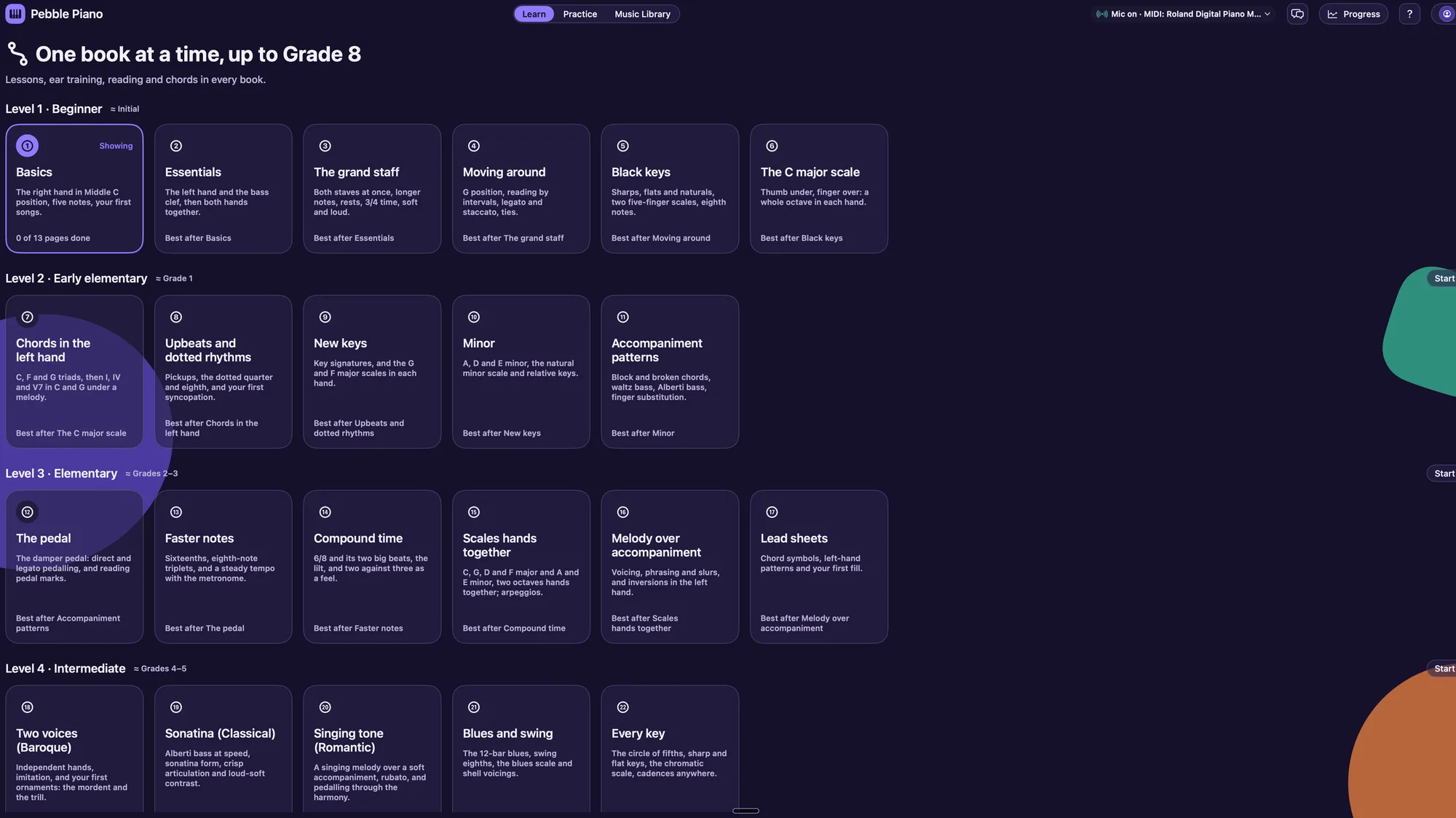
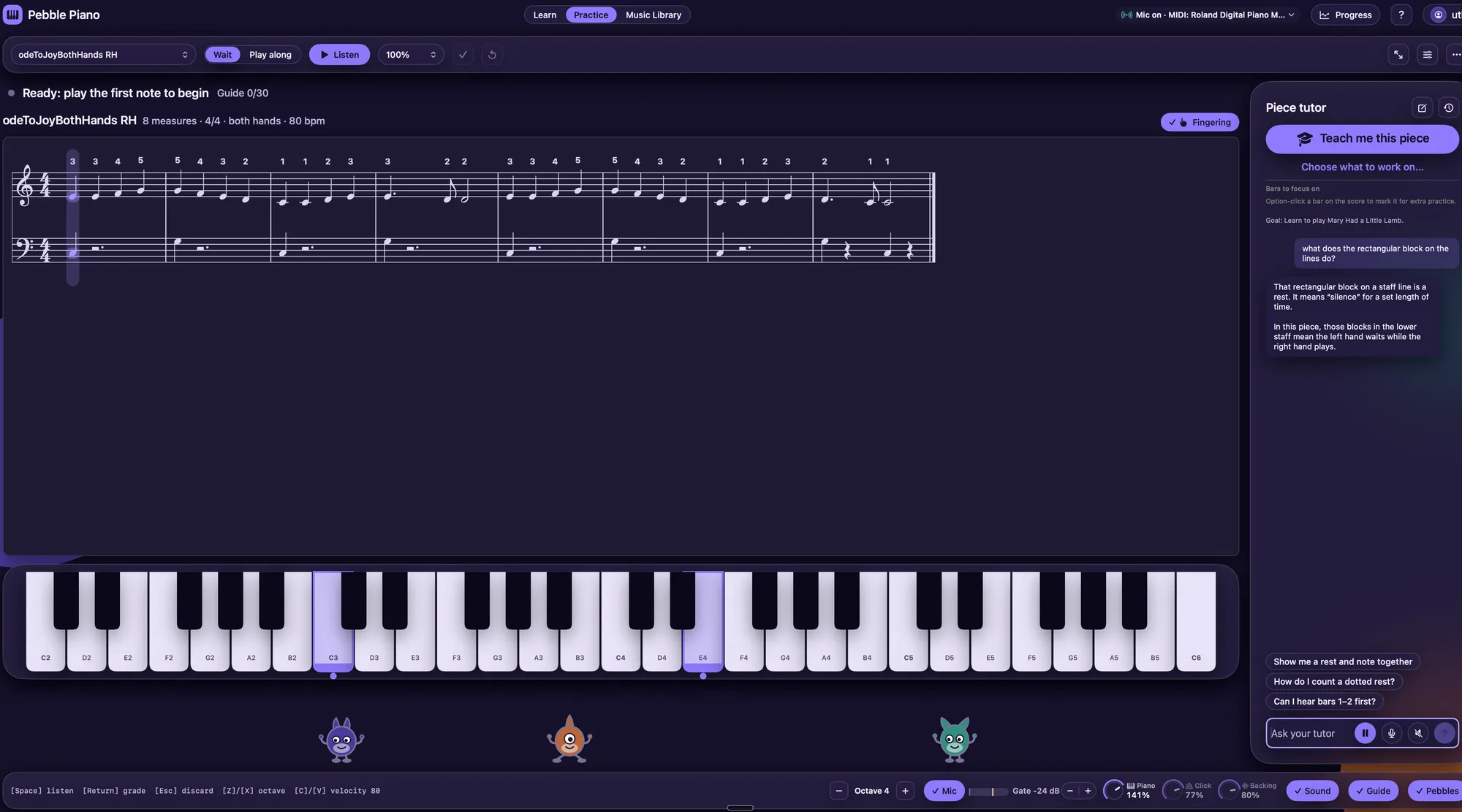
I'm building a piano tutor app that is aimed at beginners and intermediate players, supporting both mic input and midi input. The app has its own curated piano method book wherein it teaches classical music through sight reading and ear training (very much like professional piano training centers).
AI tutor tracks your playing journey, can help you learn certain pieces, answer music-related questions, and crafts custom lesson plans, just like a real tutor.
Platforms: iOS, MacOS
I'm looking for beta testers on TestFlight, so if anyone's interested please DM me.
Here's what it looks like:
This is way more polished than mine but I tried to do roughly the same thing as this but with guitar. I've had my guitar for 3 years and have barely played, my son just picked up his first. I was using Yousician, which was great, but at $200+ a year not exactly worth it to me right now. Mine has been quite buggy and I sidelined it for now with other projects on the docket but it's been a fun experiment.
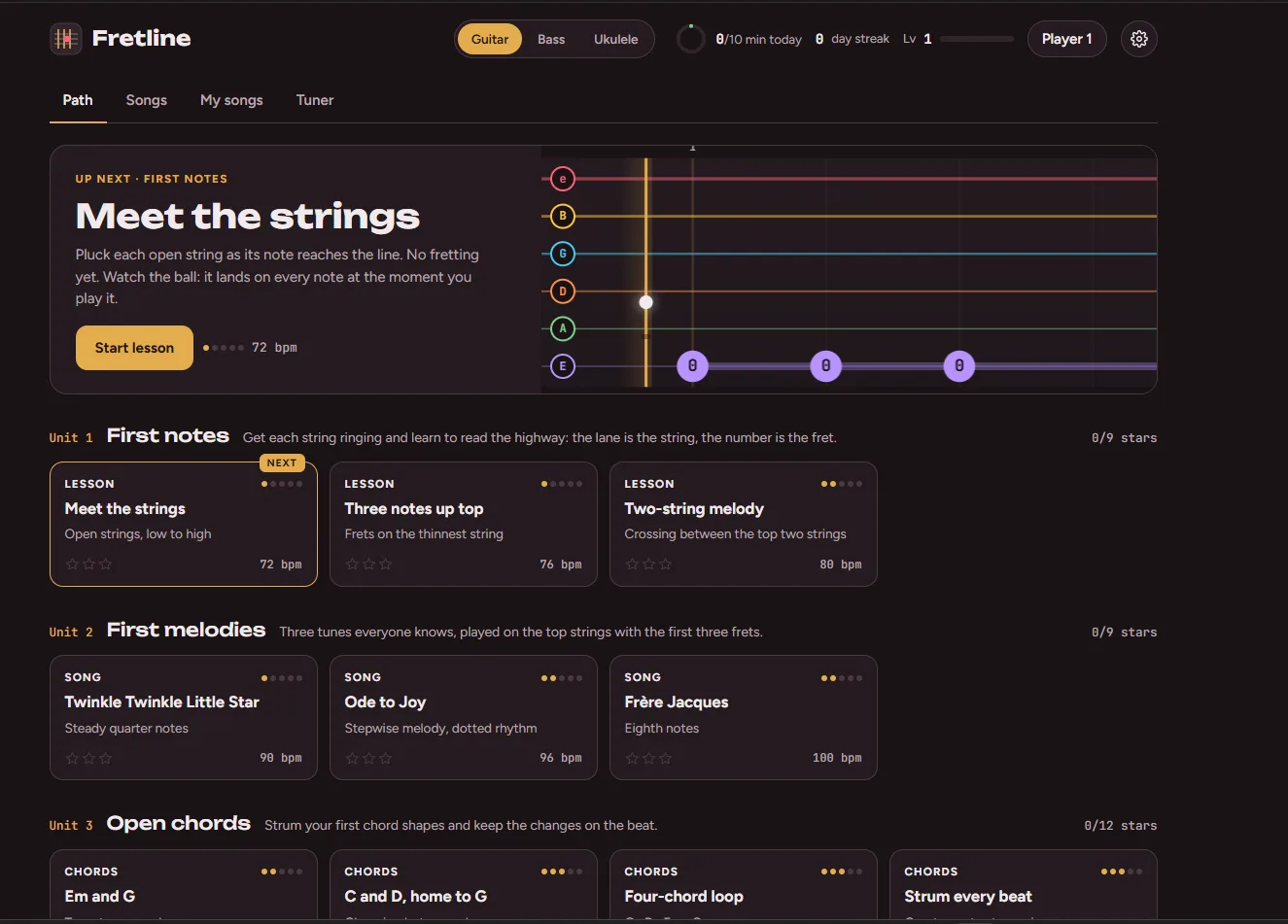
Cadento.ai
Turning off thinking halved our cost, and quality held
We draft personal follow-up emails for loan officers with Claude. On Nov 4 we ran the same contacts through two settings: the model's default thinking, and thinking off. Thinking off cost $0.056 an email vs $0.106. It passed our writing checks and voice check at the same rate. The default setting also had 6 failed tries, 3 of them because thinking used up the token limit and wrote nothing. For short, tightly specified writing, test whether you need thinking at all.
Currently working Lyre (lyrehq.com) it lets you learn a new language by listening to podcasts you already love. Same shows. Same hosts. Just in the language you want to learn. It’s still early. Happy to share access if anyone wants to try it!
What a great idea. I studied French in junior high in San Diego and it didn't stick but it did help with learning Spanish after my family moved to Mexico. Once there I was able to learn to converse fairly quickly because of my basic understanding of French but immersion is the key to learning a language for my money.
Looks like that immersion is what you are providing with the bonus of familiar content. Congrats! Sounds like a winner.
Leading copilot and agentic AI R&D as part of our advanced AI development acceleration initiative, e.g., some recent work includes:
I've been working on games using Claude for the past few months, just personal projects. The productivity is shocking - I am now at a place where I can confidently trust the model to follow task instructions and build complex games running in browser with little oversight. Tasks are fairly self contained, maybe no more than two days' coding time (for a human) which keeps their scope constrained and allows a fairly firm hand on the architecture.
I think that the indie game community should be embracing this pathway rather than seeing it as a threat, as a loan dev I can get so much further down the track than I did in earlier attempts. They may well be doing so, I'm not sufficiently tuned into that world to know how the mood is.
One thing that I personally find very helpful is that by tuning the model to be encouraging with strong ideas and critical of weaker ones, I am kept on track and enthusiastic much more than I was coding in isolation.
I hear about so many devs working on games now that Claude gives you the bandwidth to create something pretty polished on the weekends!
Yes, I think that if you know how games (or other complex systems - like a community chat board) are put together then the agent shortcuts a lot of work that you would consider trivial but time consuming. I am interested to hear how developers on Claude Pro's package manage their tokens, I use my weekly allowance up within about three days of development and find the jump to Max/Ultra too much, but using tokens in place is far too expensive. I'll post a fresh thread.
I'm working on a real estate development engine to try and solve the country's housing shortage. Lots of homes don't get built on available lots because the process of determining if a deal works financially is long, manual, and inaccurate - developers need to spend a lot of time and money just to find out a deal won't work (architects, civil, zoning/planning boards). We identify and monitor land parcels, optimize building(s) to the site, and then custom tailor outreach for developers. (We're also a robotic homebuilder, so we build them, we just need developer $$ so we keep our capital in our tech instead of tied up in the buildings/land themselves)
This is super ambitious! I would imagine that a ton of the issue is zoning / planning and getting approvals that take months, how do you guys streamline that?
Near term-zoning and planning comments mean changes to the design, so if we make our generative design fast and accurate, then we get through those cycles faster.
Long term that doesn't solve zoning boards that only meet once a month. I think there's enough public data on meeting transcripts, and previous projects (incl longitudinal data on those projects) that we can make a general predictive approval model, and tailor it to any locality we want to build in.
Good news is the current process is so godawful that we don't have to be perfect, just better! :)
Have you run across any public projects that help automate generating schemas, think like an intelligent schema that explains to the llm what terms and concepts are important and how to navigate the structure? Example agent skills, etc.?
CG deals w immense structured data with deep and deterministic associations, heterogenous, hierarchical, graph nodes, tables, human designed conventions, etc.
Schema generation is definitely one of the most important steps for GraphRAG applications. From what I experience, if the schema is built properly, the rest takes care of itself easily. This link here (github.com) is what I chanced upon that looks pretty neat!
Building a webapp with Claude Code onto our Zebra scanners to move away from paper based forms onto online forms for Fork lift Truck checks.
The main benefits include that the user cannot log on to do any work without first inspecting the forklift, improving safety. Area Managers can also see when each forklift is being used, allowing them to quickly assign someone to a forklift without having to find one free.
It also reduces a lot of paper waste, roughly 40 sheets a day.
Links into our Health and Safety software, with was built with Claude Code on Next.js allowing any issues with forklifts to be flagged on the software.
I'm building the software for a coffee shop in Philadelphia that doesn't exist yet.
BrewHub PHL is a café, parcel hub and mailbox service opening in 2027 in Point Breeze. The contractor is still working through permits; the software is already in production: POS and kitchen display, a parcel counter with a scale and locker grants a Raspberry Pi verifies offline, loyalty and wallet, a voice concierge, and an MCP server so AI assistants can order coffee for their humans. It's just me and one other developer and a lot of Claude Code. The coding agents keep a diary, which I publish on Substack.
The part that makes me nervous is agent commerce: an agent spending someone's money. What ended up holding was boring code, not prompts. OAuth consent per assistant. A $50/day cap checked in the same locked transaction as the order insert, because the first version let two parallel agent calls both pass. Server-side repricing, so the agent's total is never trusted. A kill switch. Checkout is gated until we open, so right now it's a very well-tested way to not buy coffee. (VIP access for me and appletest@brewhubphl.com for app store review)
Curious how others are bounding what an agent can do on a user's behalf, and where you put the enforcement.
brewhubsystems.com · brewhub.substack.com
I'm working on an activity logger app! It sound simple but I specced it out... probably way too much, to be able to have a massive amount of features that I personally want 😅 I started this project in a more "pre-AI" world (aka 2024) and so it's been wild to deal with scope creep and figuring out which things I can hand off to agents, which things I need to rework for today, and so on. It's fun!
Also, my own newsletter (cassidoo.co) is a passion project of mine. I've been working on it for almost 10 years and it's just a weekly, personal newsletter that has dev articles of the week, cool random links, a practice coding question, a joke, and some other goodies!
I'm curious about the activity logger! It reminds me a bit of a project of mine that (i) started pre-AI, (ii) is a sort of practical everyday use kind of application, (iii) came to be because I wanted one of its type with a certain big custom feature set, and (iv) is very amenable to piecewise enhancement with / replacement by AI, though it's not at all trivial to figure out which pieces, and how. It's a very interesting category of application to me, largely for technical reasons but also for emotional ones (they're often passion projects, and grafting AI onto a passion project one started without any idea that AI would be what it is can feel strange).
I'm looking forward to reading more about this project as you choose to write about it.
Right now, having recently been laid off during a 'downsize' that 'eliminated my position,' I'm refining a resume writing service. It's not public, and is quite simple. Having started my technical career in 1986 and given I've enjoyed almost every job I had and the role I filled, there is a wide range of areas I could happily focus and have background covering many skills and abilities posted in job descriptions. Every resume I use needs to be tweaked and tuned to the specific job. I started out building an 'evidence bank' of tech skills along with a proficiency grade based on supporting evidence I had Claude write based on background stories I recalled. It also serves as the SOT for my career chronology, education and certificates repo, proficiency and change log. I also created a template w/detailed instructions on how I wanted my resumes formatted. The template includes detailed evaluation points designed to penetrate the ATS screening that everyone uses online - a very tough wall to pierce, I've found. The jury's still out on how successful this approach is going to be. In any case, now I can bring up a job description, attach the Evidence Bank and template docx, and prompt to write a resume using only these three sources as input. It typically spends a minute thinking it over, coding its solution, checking it over, and providing a download link. I also created a detailed prompt to compare a job description with the evidence bank and evaluate the suitability of the match. I've discovered Claude isn't quite as optimistic about my range of potential as I am, and so far, when I take a second look, I've grudgingly decided Claude was right. Reading another post & comments here, I see that many of you have focused a lot more on which models write well for particular tasks, and if any of you have an opinion which would adopt the best tone and level of detail, I'd love to hear it. Claude, particularly Opus 5.5 and up, are what I'm most used to using since before my layoff, I was using ai assisted code generation.
Interesting idea. It does seem like LLM models are pretty good at refining resumes these days. It also seems like a really competitive space. Are you focussing on resume editor for someone similar to your profile?
A friend sent me a series of questions to use to assess a resume's likelihood of surviving the AST screening. It was a multipage document, so I embedded it in the Word rules & template doc I put together. I also found a website that will assess a candidate resume to grade how well it would expect the resume to survive AST. My process is find a job description that looks interesting, attach the template and my xlsx 'evidence bank,' and ask Copilot to create a resume tailored to the job description while pulling data from the evidence bank and following the format and rules in the template. The rules emphasize to never make up skills or achievements. If there are expectations the description specifies and it cannot find concrete evidence, it might tell me I have a relevant skill listed, but the evidence is weak, or maybe the skill is missing and it's a real gap. I either live with the gap or recall a story I can tell Copilot so it can add the evidence to the bank - then rewrite. After several resumes, the bank has gotten pretty extensive, and I don't have to add much more to the bank. Another check I will add if I don't get an offer in the meantime :-) is doing a word-cloud comparison between the job description and the candidate tailored resume. Often times there are terminology differences, and the word clouds can bring that to light. Currently, I'm taking a screenshot of the two word clouds and instructing Copilot to rewrite using employer terminology when it doesn't change the meaning or imply anything inaccurately. I always review, of course. About 10% of the time it makes a significant blunder, e.g., referring to the evidence bank repeatedly in the resume. About 60% of the time I make minor changes. About 30% of the time it is ready to ship. It seems like it saves time, but I've yet to land a new job!
Launched this integration with ChatGPT and Coinbase! https://x.com/coinbase/status/2122691614426751448?a=-Ls31L_P3v7hQ5cBIgA&s=46
Slowly then all at once, ChatGPT is becoming the new app store!
I think this will actually be huge for trading in particular because order books look super scary and chat is probably already much more sophisticated than the average retail trader at getting decent execution.
Yup agreed, very bullish on agentic trading and the idea of taking high-level strategies and automating them without the user having to get deep into the weeds with order books and charts and so on and so forth
iceberg-mcp-server (github.com)
iceberg-mcp-server is an MCP Server for Apache Iceberg, enabling users to read, query, and manipulate data within Iceberg catalogs. It supports reading and data manipulation using catalog types supported by PyIceberg, and supports SQL queries using catalog types compatible with DuckDB.
Also just put out my first blog post at https://www.dragonejt.dev/, but I need to find more time to write stuff lol.
Hi! I’m new here thought of sharing some of the fun stuff I’ve been building lately:
a finance bot helping me track my savings and expenses every month - GitHub Actions scheduler, fixed reporting template filled by LLM, API connectors to my neobank. Hand labeled custom categories cuz my bank’s categories are pretty meh, sends me an e-mail digest with monthly summary and recos on savings or alerts on increasing costs.
a travel advisory bot for planning trips with my fiancée - WhatsApp on the FE, MCP server with actions against a Google Sheets database (for visual inspection as needed), compatible with any LLM in the background, harness searches for trips, reminds you of bookings, settles up expenses.
Nilo - a wearable device for children with ADHD. Off the shelf wearable with React PWA for parents. Back-end classifier and signal processing for matching vitals with psychologist-approved mood diagnosis + care recommendations.
Those projects are private at the moment but Nilo is entering an accelerator program and will soon be fundraising to build a prototype of custom hardware so stay tuned for more, and happy to share my repo for the two other bot projects to those who are interested!
Thanks for your interest!
2 ways:
It uses physiological signals to inform parents and caregivers on a child's mood, and in turn provides insights to the caregivers as to how to help with regulation.
It encourages and informs medium to long term habit building by recognizing activation patterns.
There's a lot it could still do, like helping the child themselves understand their own condition. We're in early days and hope to onboard more families as we partner with clinicians for expert evaluation.
Thanks for your note! Working through the intersection of wearable SDK + signal processing + fullstack development + data science felt so seamless as a one-man engineering team with a Claude Code Max subscription. A project like this would've taken me 6 months pre-AI, we got the prototype up and running with 5 families within 2 months.
This week I'm mostly working on advocacy around the AI version of the SDLC and the OpenCode harness we are building for the company. Turns out it's almost as important as the quality of what you're building in AI.
In this 2026 time we always put in the spotlight AI enthusiast people, but in most large company there are still a lot of people that are that much AI friendly. Working on their conversion. Wololoooh (old ref)
Many reports from every conversation I have at big tech and big media and even startups around #NoAI boils down to therapeutic counseling.
Demonstrate AI first successes to build confidence; be a transparent mentor and educator to build trust; pursue corporate goals through learning, using, sharing, and aligning to build momentum.
I started testing out NVIDIA PAIR with some local models. I have Ollama and LM Studio installed on my various computers. M-series Macs and a PC with an RTX 5060 GPU.
PAIR installed on each computer allows you to use any of them for executing various AI tasks.
I create a small agent that does a simple task of enumerating GPU stats. Coded in Python on VS Code. Point the URL to the local PAIR port for Ollama and watch it assign the task to any of the available computers.
It's actually pretty cool.
Currently Gemma, Qwen, gpt-oss, Llama, and DeepSeek.
I tried Nemotron on my Mac Studio. Apparently 36GB or RAM and an M4 Max are still not quite sufficient for that large of a model. It slowed the Mac to a crawl.
It did fair a bit better on my Windows PC with 32GB and an Nvidia 5060. I have since upgraded the Windows PC to 64GB so I need to test Nemotron again on that config.
Multiple things! The most interesting two so far:
Orbweaver, an autonomous satellite constellation platform for commercial & defense that self-keeps any shape of clustered satellites (I see you cowboy!), handles collision avoidance (I see you orca!), and maximizes ground link via space networks + GNSS integrations
-> virtual lab complete, moving towards physical validation, engaged w/ more design partners
vergo, experimental Golang engine/lang modification inspired by https://arxiv.org/abs/2608.22630 that bakes static, temporal, and distributed-system verification directly into the language (think a mix of Hoare, TLA+, and SMT with reinforced type checking/assignment)... because I can only take my agent stack so far building e.g. orbweaver or client software w/ minimal+focused behavior/property-driven outcome testing guidance in multiple review rounds before the token use & time frustrates me 😂 -> lots of nuanced problems, will be open-source
Today I just launched my first product after quitting full-time work!
It's a productivity app that shows your progress on projects as a farm that you can grow and decorate. I built it mostly for myself, to gamify building with AI since I was missing intrinsic satisfaction from actual coding lol
You can try it here: https://www.tallyvale.com
A “Mission Control” for my AI agents. It’s a Notion board where Claude and ChatGPT pull projects from a shared queue, mostly in the window before my weekly credits reset so they don’t go to waste. Now I’m working on an orchestrator so I’m not the one handing out the work. Hard stops (spending money, anything public, deletes, work data) still come to me. A coworker pointed me to GitHub’s Spec Kit (https://github.com/github/spec-kit), which I shamelessly stole from, and he helped me redesign some of the autonomous guardrails and add the cost checks I didn’t have.
I also built a terrain map of my own land. I kept losing time on every outdoor project re-figuring layout, elevation and where things were, so I pulled county parcel lines, contours and USGS LiDAR into one interactive map. It has Hunt mode for stands and trail cams with a range card for our rifles, plus Plan tools for landscaping that flag shoreland setbacks as warnings without blocking anything. Now I’m extending it to my boss’s land before gun deer opener on Saturday.
Anyone else running agents off a shared queue? Curious how you keep them from losing track of work between sessions.
Why Notion, it might be simpler to use GitHub or similar for all messaging, PRs and all sorts of housekeeping tools/jobs, and Notion just as a dashboard if you like Notion
My plan is to eventually figure out a different backend. I already had my 2nd Brain built out in Notion with all the information about my projects. Claude actually talked me out of building something stand alone until I had some time proving out this workstream.
This is the dashboard I'm working off of now.
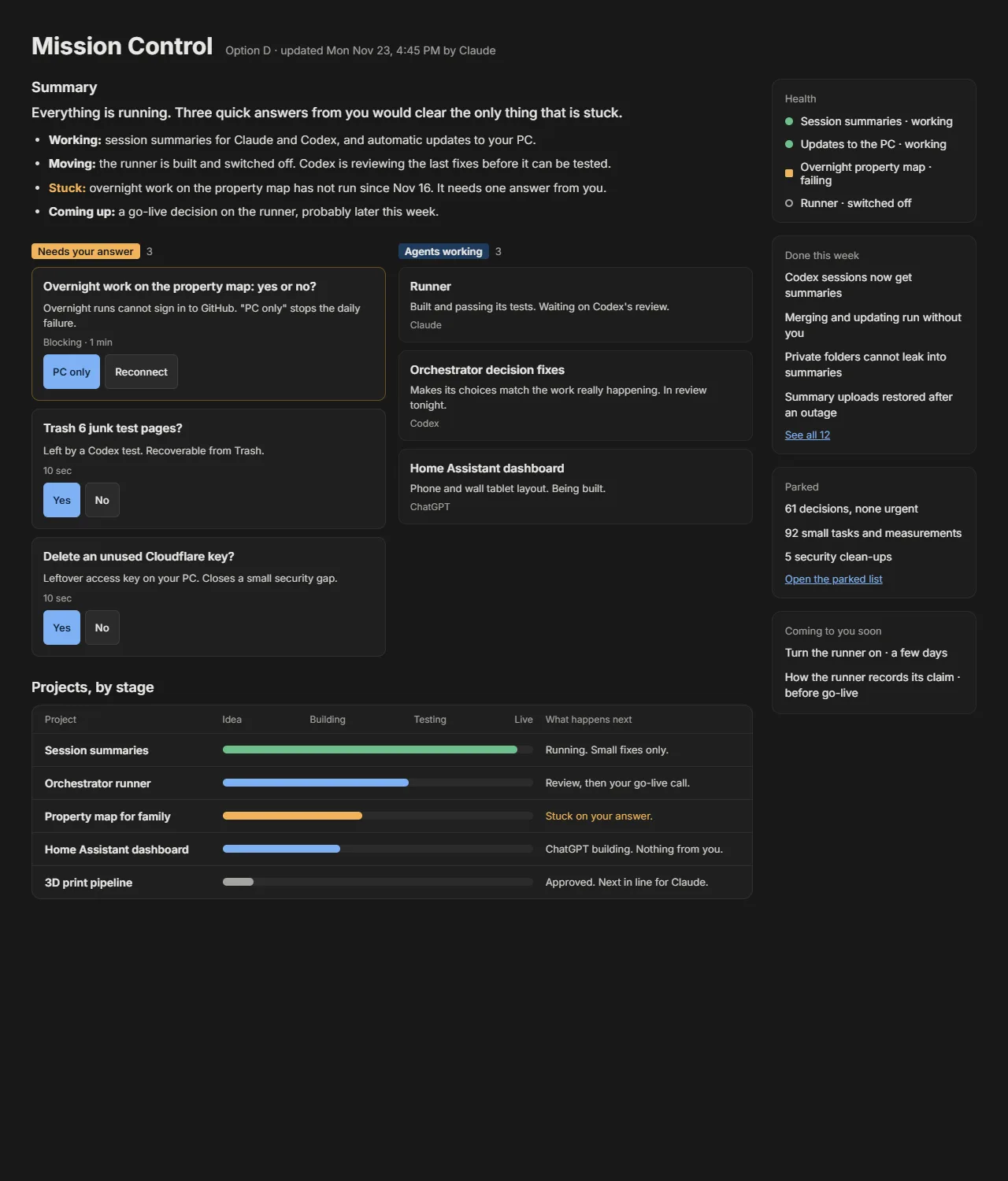
The mission control one has been a struggle. Part of that is I have a problem just pushing out a MVP. I keep finding improvements and different architecture designs that were truly core improvements. I finally stopped myself this morning and I have it running feasibility tests now. One thing I did to try to prevent the different platforms from drifting is each project/chat now writes a summary to Notion after an hour of inactivity.
The terrain map... well we'll see how this weekend goes.
Just push out 0.1 and try it! I also created a “Mission Control” plugin for our internal AI workspace (but with more modest ambitions); the genius feature I stole from a co-worker was a feedback button where I could complain about the UI or workflows. An agent picks up the feedback, builds it into a new version, then I get an “update available” button to reload the new version when ready. It’s an awesome way to iterate while using the work-in-progress productively.
I like that idea. Right now I have scheduled tasks in both Claude and ChatGPT that summarize everything that I corrected it on during the week, tell me what skills need to be updated to correct the issues I ran into, and then update & write the skills to Notion so any AI solutions I use has the same skills to work off of.
Mine works well for the general chats & projects I work through but nothing with the UI.
Last week, this week, and next week I'm working on building clinical agents that doctors can give to patients to move care forward.
This week I find myself spending a lot of time thinking about how to get LLM simulations to respond more like real people for testing. More broadly, I'm thinking a lot about how experiences need to be different across chat and voice, how to iterate based on the nearly infinite edge cases that come up, and how to efficiently design testing for systems with rare-but-real errors rates.
Side project I started this morning: Piano Time, an iPad app for five minutes of note-reading practice each morning. I'm learning piano on a Roland FP-10, and the notes app I downloaded was behind a paywall, so I built my own.
The iPad hears the piano over a USB cable (CoreMIDI) and shows one note on the treble or bass staff. The only right answer is the exact key in the exact octave. Notes I'm slow on or get wrong come back more often, so there's no speed setting to fiddle with.
What worked was doing the riskiest part first. Claude Code wrote a clickable prototype, a spec and nine tickets in one pass, then agents built the tickets one at a time, since my Mac has crashed under parallel builds before. Ticket 2 was "hear the real piano," so that build went on my iPad and I tested it on the FP-10 while the agents kept going. Eight tickets are in by end of day. Next up is a TestFlight build.
Anyone else building practice tools for themselves first?
I am learning how to build AI agents. So I made a textbook that I can read on the go with live examples. https://manual.buildanagent.fyi
This is really cool! I like the idea and the site's design too. :-)
Are you publishing content here as you learn stuff? If so, that's really smart and that's what I did as well for a long time with my blog. One of my fav quotes is "To teach is to learn twice" (my motto since 2022 (x.com) 🙌)
P.S: Followed you back on X. 👀
I'm exploring what small AI agencies and software houses struggle with most, going through hundreds of owner interviews and industry reports. One thing that stood out in a German survey of 201 agencies: 98% already use generative AI, but 62% say fewer than 10% of their clients actually ask for AI projects. If you run an agency or work with one, does that match what you see, and what's hardest right now?
two main projects, with a third that's updated less frequently now but underpins all my other work..
first, my own agent orchestration system in rust, crusteo github (github.com) - overview vid on youtube (youtube.com)
second, the fastest way to work with parquet, period - zpq github (github.com) - project site (zpq.chicagobuss.dev)
third, my agentic doc & task store, tracker (github.com)
it's been cool watching our team at work adopt tracker. It's pretty light on features but that's kind of the point. Agents figure it out really well, and start coordinating with it beautifully.
I also find it interesting that they're all in different languages - right tool for the job has never been more possible. Lots of interesting debates about software factories at work as I'm sure most of you are having as well.
The minimal task store idea really resonates. Something I've run into with coding agents is that they can preserve a perfectly coherent task summary while losing track of what's actually been verified. I've been experimenting with carrying file hashes and observed check results across compactions rather than trusting completion claims.
Does tracker distinguish agent-reported progress from independently verified state, or is that intentionally left to the agents?
100% - I hit the same problem all the time before tracker, and even with good use of it, still run into it sometimes.
But with a few simple rules and nudges, it can be a pretty amazing companion for anywhere between one and hundreds of agents..
I use one workspace in each of my personal and company trackers for recording every agent turn in a folio per agent, fed through harness hooks. This is great for deeper analytics and siphoning off what the agents are all doing for deeper analysis.
The next use case is a rudimentary task queue - agents can tell another agent "you have assignment x" and the receiver takes the task and owns it until it's done, which automatically signals the primary agent.
Finally, the standard way to use it is to just say things like "make a doc called foo in the bar folio under workspace baz" and it'll do that. There's no more hierarchy than that; anything else is just labels, and some of those are automatic (like your bearer-token for author).
It's pretty delightful -- I like to think of it like "notion, but stripped down the bare minimum, lightning fast, and self-hosted so as cheap as you need"
Okay went down the tracker repo rabbit hole haha. The expiring claims + SKIP LOCKED setup is nice.
One thing I'm curious about though: if an agent finishes the actual work but crashes before complete_task, another agent could pick it up and run it again. Are you relying on idempotency at the tool level for that, or tracking execution receipts somewhere?
Great question. Since this is basically for agent to agent use-cases only, if that happens, the lead agent is just responsible for figuring out what happened and dealing with it appropriately. It hasn't happened yet, but my leads typically have an identity that includes a 'heartbeat' which is just a term I use for 'loop with a strict set of a rules'.
One of those rules is to make sure all tasks are still being worked on, and my agents can see what other agents are doing at any time thanks to the design of crusteo's burrow.
(crusteo was built long after I had been using tracker for quite a while)
Love that you're checking it out - keep the questions coming and PRs / issues welcome!!
These week is about housekeeping (minor). I am an engineer; not a coder.
/-Completed: -Cafe-app (replacement for non-functional Caffeine app for android which could keep screen awake) -A light-weight json viewer and editor -An extension to summarize web-pages/youtube videos with my custom model pipeline -A geofencing app which could mark my attendance automatically on my company's portal as soon as I land my workplace -A local-folder-lock for my windows station to guard it against my son
/-On-going: -A jyotish engine for AI-based jyotish and analysis. -An open-source option for think-cell (extension to powerpoint).
/-Non-tech (but use of AI): -A commentary on a Sufi-book with similar references to other thinkers and spiritual seekers and traditions (stuff that is repeated across time and cultures)
I’m building a Transformer VAE that maps symbolic equations into a latent space, then testing whether small moves through that space produce useful new equation forms. This week I’ve been comparing function-aware training objectives, as well as fitting the numbers in decoded equations to see which equation proposals match data.
I would naively imagine that small moves would almost always yield similar equations? How can you get something that looks totally different but matches similar data?
It makes sense to expect that, however, the model's space is not arranged by how similar the equations look. A small move can cross a boundary where the model picks different symbols (coefficients, constants & operators), which changes the equation structurally, but different-looking equations can still give similar answers over the given data. Think how x*x and x^2 use different symbols, but they mean the same thing functionally. One of my training losses encourages those equations to be closer together so that there is "functional smoothness" in the latent space.
Working on my side hustles. www.bureausports.club and https://github.com/siebe41/SemanticRouter.NET
But mostly hunting this week (deer season)
Chipping away at my agentic hardware harness Panio (github.com); it's built for agents to be able to autonomously control systems to do automated testing, adding support for new hardware to your favorite operating system, and anything else you need an agent to be able to do without you having to swap cables or push buttons. My favorite party trick is to have it use a KVM to futz around with the BIOS settings on a PC.
The recommended / tested hardware section is super helpful, I wish more libraries came with a "this is exactly what I use" section!
The recommended / tested hardware section is super helpful, I wish more libraries came with a "this is exactly what I use" section!
I figure it's only fair to call out what I end up using myself! I have ended up trying so many things that didn't work well, and I'd feel bad if people ended up tripping over the same problems I did.
At the moment I'm working on a movie/TV series watchlist app. I've generally used a combination of Apple Notes, IMDB, Queue, & JustWatch. My goal is to build something that only requires me to use one app 95% of the time and gets to know my preferences and moods far better than anything currently on the market. Using Claude Code. I've been at it for a few weeks and it's going very well. 🎬
I'm working on a way for my father, who is retired, to parse through the human genome looking for patterns in DNA. I did the project originally myself as a Windows desktop app in C# many years ago but lately I've been using Gemini to have a "back-and-forth" discussion in terms of making it snappier and easier to use.
I'm building an agentic harness for use in developing countries, where a frontier model is simply out of budget. Getting small, cheap models to do real multi-step work reliably is much trickier than it looks! It can be frustrating if you're used to how Claude Code almost seems to read your mind when you've provided it all the right context. Would love to compare notes with anyone else running agents on small or open-weight models.
I've been working on a way to package up complete AI agents so they’re easier to reuse, share, version, and run across projects. Instead of every agent being its own one-off app, the goal is to make the whole thing (tools, skills, memory, knowledge, execution setup, etc) feel more like a reusable software package.
Can we change how an LLM sees the world through culture?
I've started Amalia, an open research project exploring how a society's cultural, scientific, linguistic and intellectual heritage can shape a language model's representation of the world.
We're starting with Argentina as a case study, small open-weight models, and reproducible experiments.
It's still early, which is exactly why I'm sharing it here.
Would you challenge the premise itself?
How would you approach the first experiments?
Have you tried something similar? What worked, and what failed?
What might we be overlooking?
I'm genuinely looking for critical perspectives, practical experiences and ideas that could challenge our assumptions.
The project is open: https://github.com/diegocofre/amalia
I'd love to hear your thoughts — especially if you disagree with our approach.
Thanks!
I broadly agree with the premise that in some ways language is upstream of thought.
There's a project called Talkie you might find interesting which is an LLM trained only on text from before 1931: https://talkie-lm.com/introducing-talkie
Working on a terminal output simplifier, so basically it reads the output of a terminal command and a local model reads and summarizes it in a simple sentence.
Also I have finished a SendToKobo (Similar to sendToKindle) for my Kobo klara, I have modified the firmware of the Kobo to allow to contact my VPS and my VPS has this API server that is listening to these sync requests. I can send my epub books and also links of articles to a Telegram bot, that elaborates the requests and stores them on the server. Then when the Kobo starts it downloads automatically everything.
Working on grai, a deterministic Markdown linter that catches formulaic AI writing patterns before a human editor has to.
This week's lesson came from breaking my own assumptions. I ran 6 fiction scenes through the exact ruleset I built for essays. Every single scene passed the lint check, yet a human reader still lost track of who was speaking. Turns out cadence and anti-slop rules don't transfer across genres. A clean lint run only proves the draft dodged known cliches, not that the prose actually holds together.
Currently splitting genre profiles so dialogue pacing and speaker attribution get their own deterministic checks without choking narrative voice.
I’m working with Codex on an online course that will walk people through an AI supply chain. Not perfectly and not in full detail, but enough to help someone with some technical background to get a better grasp on what all goes into creating and developing these systems. From Earth to Answer (e2a.bryonmiller.com)
I’m also working on a PhD dissertation on Evaluating Local AI-Assisted Cyber Defense and another side project related to evaluating AI-assisted mediation and escalation in vague, cyber crisis situations between imaginary nation-states. The Third Chair (thirdchair.bryonmiller.com)
I’d love feedback on any and all of these. I’m happy to return the favor as well!
This morning I heard that MS To Do was shutting down, which is a bummer as it's one of the few MS apps that's simple and easy to use. I'm planning on building a replacement, and even if it's just for me, at least I'll have something. But in the meantime, I built a quick exporter: https://todoexport.netlify.app/
I'd never considered that vibe coding could be a great way for a community to form and take over when software projects get shut down.
@nate and I talk all the time about building a spiritual successor to Google Reader!
Big +1 to this. As tricky as it would have been to build a Google Reader replacement (see the various attempts at it back when it shut down), AI would have made the chances of success a lot higher.
I had thought that I'd tried every major to-do app in existence, but I've never tried Microsoft To Do! Best of luck with that project.
A buddy of mine has built a damn good Google Reader type app - https://feedhouse.app/.
Also, I ended up building my own To Do :)
Scwote. It's a NeoVim based editor for MacOS 26+. Focus is on speed and being able to keep my hands in typing position while still having a file browser and live preview.
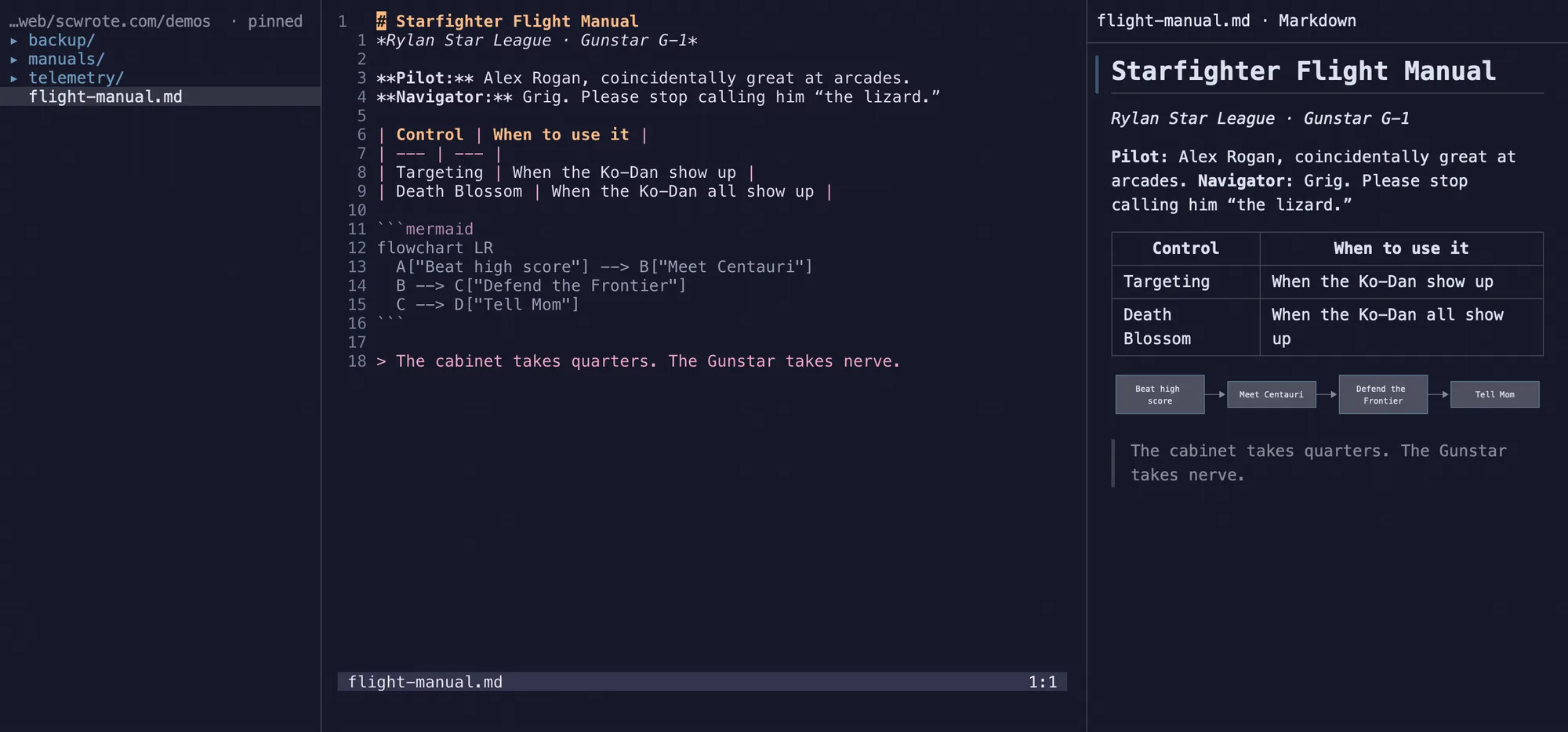
https://github.com/commoncosmo/scwrote
Currently Mac only but I want to do Windows and Linux versions. I'm focused on staying as native as possible on all platforms so each will probably take some digging and will be different projects.
I'm also looking to integrate some AI functionality for file/content creation, review, etc... While I may support hosted providers, the focus will tend to be on on-prem and on-device models.
A personal photo management suite for my wife's and my personal family photos 135,000+. Stored locally on my NAS.
An indexer that runs in the background using multiple open source models to caption the pictures, face detect, face classify, score the photographic aesthetics, ocr, sort out blurry or duplicates, pull in meta data, and much more.
A searcher with front end and backend that allows semantic search, chat bot, auto trip grouping, yearly family photo book generation, remember this, find similar, share to, metadata search and much more. Android and web interfaces over Tailscale.
All vibe coded by a non SWE.
I'm building GSD Task Manager (gsdtaskmanager.com), a free, local-first Eisenhower Matrix app for web, iPhone, iPad, and Mac. Tasks stay on your device by default, sync is optional and doesn't need an account, and there are no analytics or ads.
This week I'm bringing web, iOS, and Android to feature parity so the native Android app can leave closed testing on Google Play. I'm running that sprint with a team of Claude Code agents, one per platform repo.
The part this crowd might like is the MCP server. One command (
npx gsd-mcp-server --setup) lets Claude list, search, create, and complete tasks and pull deadline analytics. Writes support a dry run, so you see the change before it happens. The web app and MCP server are both MIT-licensed.Happy to compare notes with anyone who has tried getting an agent to manage their to-do list.
Internally we use Linear for project management but I don't think anyone really logs in anymore, almost all usage is via MCP!
How are you syncing without an account?
Okay hear me out... as almost all of our agentic tool usage is via CLI tools (Notion, Playwright, Linear, Cloudflare, AWS, and so on) because it saves lots of time and tokens + makes validation easier for multi-call script usage from experience
Drawing from inspo from The Pragmatic Engineer's Pulse: I think there should be a weekly (or perhaps daily at scale) submitted debate topic
This made me think "MCP or CLI?" would be a sick thread to see everyone speak to
Count me in for that thread. My current split is CLI when I’m scripting or running a loop, since kbruce is right about the token savings and easier validation. I reach for MCP when the agent has no shell, like Claude on the web or mobile, or when a write needs a typed schema and a preview first. That second case is why I added dry-run support to GSD’s MCP writes.
Dan, if you start it, I’ll bring the first hot take.
Good catch, and my wording was off. The app doesn’t need an account, and sync is off by default, so your tasks stay on your device. Turning on sync means an OAuth sign-in with Google, GitHub, or Apple, so there’s no GSD password to manage, and the server keeps a copy for your account. If you’d rather not use mine, you can self-host the web app and sync backend with the Docker stack in the repo.
Linear going MCP-first is great to hear. Does anyone on your team still open it for planning or roadmap views, or has MCP replaced that too?
I don't think our usage is complex enough to need a full blown version of those views, I can imagine much larger teams still needing a UI for that type of stuff!
A Playwright test framework and a skills library with the skill.md and a reference folder with relevant references used by the skill .. this skills library can serve both ai playwright frameworks and non ai playwright frameworks
My co-founder and I have been working with an offshore team for the past several years to build a new product in the printed photo products space. It's been years of frustrations working with them and a lot of money spent overcoming both technical and procedural challenges.
This week I decided to build it myself in Claude Code. Within three days, we have a completely functional app running on AWS and shipped to TestFlight. As a bootstrapped startup, we had to make many economic choices that cut features we dreamed of out of the budget. We've built nearly all of them already and I don't see anything stopping us from completing the others.
This whole experience feels like something out of Hollywood where the main mission fails but there was actually a secret backup plan! Lol!
I’m a software engineer at Comprehend Health, building an AI scribe for the PT industry. I’m currently working on a self-serve onboarding and support tool for our AI scribe that will allow non-technical PTs to onboard and learn to use our product. Support and Onboarding is a constraint to our growth currently. Playground.Comprehendpt.ai
I am trying to build the platform that extract the business functionality from the legacy code starting with java first then moving on to other languages like .net, COBOL etc.. and then create the high quality functional tests and write the corresponding test code and run it. Feel free to comment on your approach how you would design it..
Hey folks! I built gazette.sreenitya.in in the past week.
Reading long emails has always felt kinda boring (blaming Instagram for my attention span 😭), so I took some inspiration from the Daily Prophet and built my own version of it.
Would love to hear what you think! :)
This past week while on vacation with my family I built these:
Wiki Walk (walk.xoleigh.com) is a web app that uses your GPS location to find nearby Wikipedia articles, sorted by distance, with optional read-aloud.
TV Rex (tv.xoleigh.com) is a web app where friends and family rate and review TV shows and movies for each other, with watch lists, where-to-stream info and a weekly picks email.
xoleigh homepage (xoleigh.com) for updates
The iOS app for Muesli (muesli.ing), a reader you talk to. The part I'm on this week: reading a physical book with my phone locked beside me, saying what I think out loud, and having it turn into notes I can act on. No screen needed.
I really like this idea, I do find myself wanting my phone to just be locked and listening surprisingly often (especially while reading or doing something that requires full concentration), wouldn't be surprised if voice becomes the dominant mode of interacting with the phone long term.
For Muesli it's been a great way to bridge physical books and digital notes. Claude's first suggestion was to take a photo of the page you're on, but that pulls you right out of the flow and kind of defeats the point.
Voice is pretty universal too. We've got a Laravel web app and a native SwiftUI app, each with its own idioms, but talking is just the same on both.
I am working on a replacement for Zoom Teams and Meet, both as a product and a developer sdk. www.hiyve.io is live and had hosted over 300,000 calls. Our angle is to embed an mcp and agent that monitors facial expressions, speech patterns, mood and sentiment to provide real time coaching during sales calls. With an sdk for companies to build out their own video conferencing products.
Congrats on the traction too, 300,000 calls is insanely impressive!
This is the perfect wedge to own many parts of the sales process, almost everything that eventually flows into a CRM is actually downstream of a video call now.
It watches triggers like new files in Downloads, incoming mail and iMessages, upcoming meetings, and your active app. When something comes up, it checks with a model to see if there's a helpful action (like filing a PDF invoice that just landed) and surfaces a card you can approve or dismiss.
A few things I focused on:
Approval-first cards: File moves, reminders, and email drafts wait for a click; only read-only actions skip approval.
Local by default with MLX: Runs locally on Apple Silicon (macOS 14+), with optional cloud API keys (OpenAI, Anthropic, Gemini, Groq, OpenRouter) and a ledger in Settings showing anything that left the Mac that day.
Self-authored, sandboxed tools: When you repeat a manual workflow, it can propose a small tool—you inspect the full source first, and each tool runs in a short-lived sandbox-exec process backed by its own git repo for easy rollbacks.
It's free and MIT-licensed, and the source code is on GitHub. Still early, so very curious how others handle approval UX and local model ergonomics on long-running background helpers.https://bforsyth1234.github.io/bot-inator/
For our internal long running tasks the default convention is Slack ping but if the Slack ping is ignored it falls back to a sensible default instead of hanging forever!
Nice, the fallback is the part most people forget. Mine goes the other way: If you ignore a card it just times out and nothing happens. File stays where it was, draft never sends. Didn’t feel right having it guess “yes” on someone’s Mac
Ignored cards do count against whatever triggered them though, so if you keep ignoring a certain kind it backs off and shows up less
How do you pick the default on yours? Per task or one rule for everything?
Glimpse of AGI? Maybe/not, I can't say. Still cool. I can't share the project because most everything I do is behind an NDA.
The nuts and bolts: I asked Claude how to shrink video files because I needed them analyzed for a Figma build I was working on. Turns out there wasn't a good way to do that.
On its own, Claude created a build "The Frame Extractor" to upload the video and transcript, capture screenshots every second or so, give me a zip, then feed back in and it creates the code for Figma.
All without my input. On its own. I use it daily now. It works fantastic. I'm rolling it out to my entire team.
I'm exploring this more. How can I ask better questions. Less specific. Tell it the problem and let it figure out how to get there.
Building Redavio (redavio.com). Open-source tools built specifically for B2B SaaS performance marketers, likely at early-stage startups, shipped as skills and an MCP server. The intent is to take on more complex problems, in addition to standard workflows like building campaigns. Things like breaking down the attributes in your marketing to flag what works and what doesn’t, then auto-testing.
I'm curious how others here are shipping faster with agents. What’s made the biggest difference for you? Using Claude Code exclusively. Always trying to level up.
Something I think gets overlooked in discussions about autonomous AI agents is what happens when they interact with money.
Giving an agent permission to initiate a payment is not the same as establishing appropriate controls around that payment.
There needs to be a clear authorization boundary, an identifiable transaction instruction, and a way to reconcile the resulting provider-side events.
Building a payouts verification layer has made me particularly interested in this problem.
I believe financial controls need to evolve alongside agent capabilities, not several years after them.
OpenHands personas at home on a mini-PC, DGX Spark running vLLM/Qwen3.8-flash-next, and workstation w 3090. Over 1B tokens in the last two weeks but that's prompting it when I have time.
"Research" was the first one; I asked (OpenHands) chat to reference the default system prompt and write a new one. Then created a custom persona. It's working pretty good and seems to code less.
"ComfyUI skills" to convert and test comfy-skills to OpenHands and ensure environment support for a local comfy workstation.
"Warcraft II web multiplayer"
"Web In Browser Local voice chat"
"Bible Study"
... pretty much any random concept that makes room in my head for real world issues.
At home it's 100% local; until qwen3.6 even moderate coding was out of reach. But qwen3.8-flash-next is scraping by.
I probably won't use frontier at home because the lessons working with lesser models at home helps me focus my time at work on techniques and challenges learned quickly at home.
Now on GitHub: https://github.com/montgomery-ian/ChordProEditor/tree/main
I'm working on fine tuning - ScamSec (scamsec.com) - It's a project I've had in mind for years to assist people identify scams delivered by email (sms & chat apps in the pipeline). Soft launched last week and gaining some initial insights around onboarding and responses with my contacts before starting advertising in a couple of weeks. I'd really appreciate any feedback the community has :)
I'm building Ceviche (ceviche.ai), AI software that helps PE and VC finance teams split shared expenses across their funds, with the backup for every allocation, in place of Excel spreadsheets. This week, we just rolled out a read-only MCP server, so finance teams can query their bills, allocations, and fund invoices from an AI assistant, and we are demoing it with our customers now
I am currently working an a Graph based, agent agnostic and distributed dark factory, but I have the feeling that I miss something's important. I didn't saw someone presenting similar opensource projects. Do you know a project which is similar to mine? What do you think about the necessity? How do you solve the goal drift in long running sessions?
I think this might be similar? https://github.com/vercel-labs/eve-software-factory-template
Hi everybody, this is my first post. I am building an interface for Claude and ChatGPT to edit your videos. I built an editor underneath this interface that allows you to upload your videos, either 16 by 9 or 9 by 16, voiceovers, and anything that you want in your video script. You put it through, ingest everything, and you get to look at a storyboard, make your changes, and send any changes to AI. It spits out a finished video, or you can get a timeline for Premiere Pro or DaVinci if you want to finesse it if you're a video editor. I just launched it and would love to know what you guys think. Check out https://thecuttingroom.net and let me know if you think this is a viable app.
I’m building a judge model, a coding task classifier. Super fun. Feel free to give me ideas to get coding session dataset ;)
The top thing on my wishlist would be a smart way for a model to give me an ETA for every task. It's would be super useful to understand if a task is likely to take 5 min, 30 min or 2 hrs, even if the error bars are quite wide, I lose a huge amount of productivity by checking in hours later on something that took a subagent 5 minutes to finish.
I am senior iOS dev, my first app in AppStore went live more than 15 years ago (maybe that makes me vintage, not senior, lol). Anyway, this February I came out of stealth / semi-retirement and started a new wave of apps, but with AI assisted development, and focusing on solving problems for myself first. In total, there are 15 apps (you can see the full list here (dragosroua.com).
For this, I'm using my own workflow, starting with a "genesis iOS prompt" and ending with a special Grok bot that takes care of all the updates and features.
Here is the repo for the genesis prompt: https://github.com/dragosroua/ios-app-genesis-mega-prompt And here's the link to the published Grok bot: https://x.ai/bot/JaXyZXGmAwJCwwLgdRIP-
Hope it's helpful!
I'd rather say what I'm NOT building 😁
Inspired by PokeClaw, I spent six weeks building a Chrome automation agent on Android: Haiku 5.5 planned, Jev judged, and together they navigated sites and even bought groceries.
Then I tried Grok Bot. It did everything mine was supposed to do, only better. So I shelved it: https://github.com/RuneL89/chrome-navigator
The lesson I learned from this: Experimenting on personal projects is great, but I should never be too proud to abandon them. Everything is a learning opportunity.
A cognitive science thesis on what AI Builders feel about the technology that they are building. This project asks which kind of awe AI evokes in the people closest to it. https://www.feelingthemachine.com
HiGHS Optimizer (https://highs.dev/) as a tool leveraged by a deterministic explainer system
I'm working on a better onboarding flow for my app ivee (ivee.jobs)
It helps non-technical people use AI like experts. ivee lives inside your AI tools, turning messy thoughts into sharper prompts, so you get better output, faster.
The new MacOS update stole the hotkey I was using for the new Siri update (command + shift + space)!!
If anyone has any hotkey ideas (that aren't already taken on Mac or by other popular apps) then let me know. Users can change the hotkey themselves in settings but ideally we have one that works for the majority of people.
Working on a net worth investing and savings tracker to try and trick myself into gamifying investing so that I can continue to do so and still feel like I'm making substantial progress in my financial goals even though financial independence is probably decades away.
Right now really barebones: https://worthparty.com/ - but I'm playing around with a couple of ideas like badges, public data entry like levels.fyi for users to get a heat map for "Keeping Up With The Jones" instead of just relying on recommendation algorithms from people who already made it on social media.
Also when I started building it, I decided against integrations with wealth platforms because I think I want user trust and I think other net worth applications cause us to give up a lot of important information about our lives to 3rd parties, even though it might not be direct access. I think I'll stick with manual entry at least for now because it feels the least harmful and risky for users.
Kinda boring, but if I can make it at least interesting for me, then there's one user benefiting positively :D
Running multi-day simulations based on real-life business situations to benchmark models on quality / price and optimize towards a general-purpose harness. Some of the cheapest models can get surprisingly close to parity at 10x less cost with the right system, but I am discovering it's all about that final 15% of quality, that really takes a push
We've had enough Hurdle customers (check us out (hurdle.ai)) ask for Slack integration that I've had to suck it up and build that out. Already cursed myself as someone is now asking for a Teams integration...
I haven't published this yet but we run a bunch of evals on complex sales tasks, I'll cut out a public version of the tasks to show how the frontier models are performing at real sales work. I had the chance to run Astra 6.2 today and found some good results (better substantiated claims in assessing deal progression) but interesting less financial/data details in an ROI case compared to Fable 5.2.
Great rule of thumb from back when I ran a SaaS company: anything you really don't want to do goes behind the Enterprise "Call Us" plan and gets a custom price!
I think Patrick Mackenzie once wrote something along the lines of "if you find yourself resenting a customer, you simply have not charged them enough".
It's not about what I am building this week but what I decided to audit and how. I have been bouncing between ChatGPT, Claude, Muse and Grok. I use Muse mostly as my personal assistant. I set up a group of agents in Grok with a chief of staff and most recently had Grok audit one of my websites. The results were interesting! I built most of my website using Claude prompted by Chat and deployed via Netlify (a great ElevenLabs automation concept of my logo exists on the site too, I am the proudest of that one). What Grok found was the following: there were 3 site links within my website schema that I did not own, nor did I say should be included in the build. To be fair to myself, I am not a coder, I am just an AI obsessed deployment engineer type who translates this stuff. Aka learning by doing. As AI Evolves how much time do you spend going back to fact check and refine previous builds????? What is your Audit workflow process?
I’m working on the future of executive support. It’s been months of work, relying on my 16+ years of supporting executives, knowing how they think and how decisions are made, and I’m excited to have joined a company that is adopting my theses and is allowing me to build the tools that enable them at scale. Lately I’ve been working with ChatGPT to crawl Confluence / Jira to identify issues that will reach executives before they get surfaced so a solution can be already prepared in the instance it reaches that level. No meeting needed (or shorter meeting needed), and no trying to squeeze time into an executive’s already packed calendar.
This week I'm building an agent board for our company, where agents with different roles can work with one another. Building the board was the easy part, obviously. The challenge was in context engineering. Curating the context we accumulated over the last two years into the right setup of files, including instructions for agents about which ones to read and when. I'm really liking the results so far!
I used Fable 5.2 trial version and built core components for a full harness. I started building applications using Claude Code. I built and published 4 apps and asked Claude to help me find gaps that existed to have a full functional Harness. I must say that Fable 5.2’s ability to execute was slightly better than Opus 5.5. However, I am still a novice and learning each day
Kith Moot: solo 5e adventures where the AI tells the story and the engine runs the rules
I'm building Kith Moot, a browser game for when you can't get a table together. You make a hero, and an AI narrator runs the adventure with you, solo or with friends.
The main design choice: the AI never decides what happens mechanically. A rules engine handles dice, attacks, spells, HP and conditions, and the narrator only describes the results. That stops the model from fudging rolls, forgetting your inventory or letting you talk your way past a locked door. It also keeps runs cheap enough to offer a free tier.
Recent additions: a Chronicle that remembers the people and places from past sessions, and invite links so friends can join your game. It's in open beta. Free is 25 turns a day, paid starts at $5.99 a month, or $2.99 if you bring your own API key.
I'd love feedback from other builders, especially on keeping long campaigns coherent. kithmoot.com/go/tldr
For my current clients:
Harness Engineering
cofounderOS - A neat plugin for Claude Code that acts as an effective digital twin on an inference-agnostic memory system
forgeOS - A Claude Code plugin that combines all of my industry knowledge of the SDLC to an agentic system that manages a small swarm for targeted goal-oriented development
Development
Utilising best practice cloud and agentic development to deliver a governed centralised platform for AI use cases, workflows and utilities for a ~$35m prop-tech service provider.
For non-profits, side of desk-ish: Arty (artilfracombe.co.uk) - A multi-tenant SaaS platform for Art trails, currently piloting with a trail I have an existing relationship with.
Building a new AI model router that leverages decision models to handle the cost/complexity classification to choose the right provider and model to route each call to. Also integrating the router to an AI gateway to make it easy to leverage this new router across all of the tools we are working on internally.
Since AI agents are becoming so good at programming now, it is about time to stop using it for software development and instead build the tools that allow organization to safely operate and have their people build their own tooling, the way they need it whenever they need it. It makes no sense for a group of engineers to try and come up with generic solutions that should work for everyone across a department or business but that -because of that- don't really work well for anyone.
With Axiomony (github.com) I am turning that around. Axiomony lets you define a shared database with rules and permissions, and then lets regular people connect to that database via MCP with their own AI agent of choice. They can build whatever they need without being confined by some arbitrary rules that other "no-code" solutions carry (like a fixed UI or limited field types, etc). The tools people make can run as a web app, on their phones, or even on their watches if they want to. Imagine someone working in a warehouse who instead of carrying a handheld device around, can just look and talk to their watch to find where to find a specific article. Their colleague might actually want to do this via TTS on their earbuds and a third person may not want any of that and instead builds just a plain app on their phone that she's pulling from her pocket every now and then.
i'm working on my project haraesume - haraesume.ackberry.dev apart from that, I have an influx of ideas and overload on my mind, so trying to clairify all of that
also, I am building Neem labs - CI/CD for sound/light production. I work as a Sound and Light Engineer at my school (im a junior) and come across a lot of problems while in prod, so I want to make a stimulated env where i can test diff scenarios + catch them fast, and then find a way to implement them irl
Working on bringing the ai agents you already use into video calls as teammates with their own names, voices, and ‘humanlike’ animated portrait avatars.
Connect agents, save an identity for each one, and paste the meeting link to bring them into the conversation.
Think daily standup but with your team of agents.
Currently doing final API/Documentation review for:
https://loadoutai.dev - unify & compose agent configs across different agents and projects https://splashdown.dev - automate management of development resources (ports, Docker, mobile device emulators, vms) on a machine, so agents don't get into conflict or exhaust the machine https://github.com/nielsmadan/pratfall - cross-agent non-interactive mode cli, like llm cli but for agents.
All free / open-source.
I've got a bunch of stuff to do at the lab today. I'll check back later.
Curious about people's thoughts on Jensen Huang, NVidia, and the future of the AI Buildout.
I am (building) > writing a monthly newsletter on AI for people who don't have time to keep up with AI news. Audience is primarily marketing folks in Germany, so rather niche but I enjoy the researching and writing process tremendously. It brings me back to university days where every new book or source material challenged the way you thought about something. Plus it motivates me to exchange more with people who are curious about technology and its impact on society. Which is what brought me here. So, hi everyone! Happy to be part of this community.
Thanks! It's called From Nerd To You and actually dates back to the early 2000s, when I used to do something similar, just with Facebook and gaming updates instead. 😅 https://fromnerdtoyou.substack.com/
I am building GrowthPostHQ to help me to get into the habit of sharing my expertise and insights on a regular basis, instead of prompting AI to write posts, I get it to prompt me and ask about insights and stuff that came up during the week to write about
I've been building a newsletter to help me keep up with the stock market before and after the bell. Under the hood it takes a lot of signals and AI ranks and evaluates key info I need to know about what's moving the markets each day. https://parabolic.email
Currently writing a book about the lessons I learned over the years as a paramedic and as a programmer and how those skills work together in agentic workflows https://www.stevencarlson.com/standing-orders/
Hello! Thank you for the invite, Dan, much appreciated! I hope to contribute as many things as possible! Wow, what am I building this week.. The weeks seem to go by so fast lately, unreal the things we are able to accomplish now with the help of AI and the money spent on multiple Subs, lol.. I'm not sure if we can post links here, so I apologize in advance if they are not allowed, not a shill just showing off what's accomplished. Please remove if necessary. kennyski.com <-- personal site youraris.com <-- Similar to Claude Code's Desktop app, but better. Fork of Theo's T3 Code. conciergemedia.ai <-- Co-Owner of this, still working out the bugs meetmya.ai <-- sister site to conciergemedia, small % partner nextlevelappraisal.com <-- what I am most proud of right now. 3.6 software for appraisers across the US. My Girl has been an appraiser for 23 years, new software is coming out and most of it sucks, so I said why not build the best one available yea?? books.nextlevelappraisal.com <-- QuickBooks clone still in Dev. I am a disruptor, QBooks is too expensive and I am going to change that. aceindicators.com <-- My charting software in lieu of Trading View Finally, thescreamery.com been in biz in my town since 2014, now biz partners with my Ex Wife, this one is soon to go away, it's time and we are struggling TBH. Off to bigger and better things.
Aris is my "AI Brand" and have been building a Browser off of Chrome's Engine, the engine is stripped out to how I want it, AI is heavily involved. Email integrates AI also, and connected to the Browser.
I am HEAVILY into Crypto, have been since 2017, I am currently waiting on parts for a Hardware wallet integrating into a "soft" wallet which works 110%.
I have a few Apple Store apps, nothing to brag about..
I do work on all of this daily TBH.
Kenny
Building an online gamedev system (that uses threejs) so you can build 3d or 2d games. I've already started about 6 games that are pretty good. https://voidlux.com
So many things ahahahah
Https://openpoker.ai https://openworldclock.com
And playing around with local models to fine tune them to detect risks in phitis of electric components
I'm building a build-in-public tool this week!! I started a few weeks ago because I was frustrated with the immense amount of work it takes to really build in public. My goal for it to become the one platform solo builders can use to track their progress and more. I am so excited to share more details about it soon!! :D (EDIT: It's AI driven ofc)
Contributing to an opensource second brain, full local, full control
I'm put inside all digital infos, except social (that are still not integrated) so, WhatsApp, Telegram, email, bank, browser history, phone usage.
Then, a local agent (for me is mandatory) can query these data. You can link this to external agent also with privacy policy
I'm also working on always on always recording devices to capture also audio and store that and transcribe
I am building a business that will operate while I am not. I’m trying to start new passive income while continuing working for someone else for at least next year or two
Bowwizard.com = trained an AI model to learn how to detect arrows in a target, then measure the distance between arrows and bullseye, additionally there is now an automated scoring system and a Garmin watch app to monitor your hand movement while holding and shooting. Really fun working on this project. Very different than the normal WebRTC work I do.


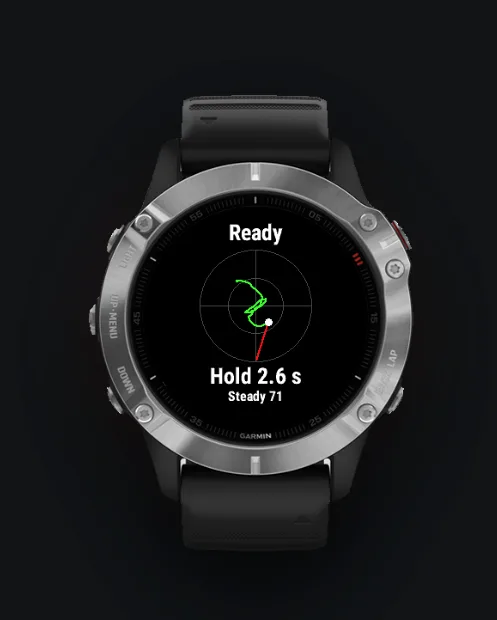
The recent upgrade to JEV, which allows it to process images, is pretty impressive.
Among other things, I fed JEV an image of two identical car doors, one of which had a really faint scratch on it, and JEV was able to identify and draw a bounding box around it. I wrote up my findings in an article on the Towards Data Science platform. It's free to read using the link below.
I'm trying to get Claude Code to keep its promises in conversations without getting distracted like a dog by a squirrel.
Not sure if you know, Anthropic releases updates on prompting for each new model, with details on how to improve specific model quality of output, with few more good info in the same guide
https://platform.claude.com/docs/en/build-with-claude/prompt-engineering/overview
What a goldmine, ynot. Thank you. Can I ask my own Claude instance to reference the Opus 5.5 and Fable 5.2 pages and suggest pruning options and updates? Or is this something I need to do with brute human intellect?
That is what I did, I asked my coordinator Claude to talk to other sessions agents with these guides in mind, there are similar guides from Codex and Gemini, so it speaks their language too, so to speak
If you are talking about two separate sessions using their own claude.md you can do that when you start Claude Code, you just provide a model specific .md, so claude.md is shared by all in that folder/repo, but you add model specific .md as a start parameter
Something like that - claude --append-system-prompt-file opus-5_5.md
Opensource openhardware ring, band and card.
I'm tired of closed things.... in this world of AI
I'm testing local AI models that fit on a 16GB MacBook Pro. All screen recordings are not sped up or edited, so you get exactly what you'd experience on your own machine. 16 models tested so far, from well known performers like Qwen, Gemma or Nemotron, up to exotic players like K2 Horizon, Raon 1 nano or Domyn Edge 4B.
For this week I already recorded the raw footage for 3 new models: a DeepSeek distillation on top of Qwen, a new European model, Olala and SenseNova. Should be edited and published by the end of the week.
If you're interested in this kind of content, here's the playlist: https://www.youtube.com/playlist?list=PLYoyB8nx4G30
Q: User validation and approval of autonomous agent actions but isolated authorization?
Agent runs autonomous all day then needs access to resources. Like AWS SSM Automation maybe? But isolated in a way agent has minimal access.
Mechanisms to give agents credentials that require human in the loop approvals. Maybe like a special action in AWS IAM permissions... "write-with-approval" along with templates that control presentation to user approval.
I would like this when running vscode Copilot autopilot mode, OpenHands, etc.
And approval gates for:
GitHub merging to main.
AWS ec2 launch, add domain, etc.
write access to these approval templates themselves, so I can review an agent attempt to write these templates.
approve urls for domains.
mount/file access.
sql queries.
Or....
Is there something I haven't discovered yet that eliminates risk completely... like an AI company that provides full indemnity. Someone mentioned a popular standard called "roll the dice"?
For my current clients:
Harness Engineering
cofounderOS - A neat plugin for Claude Code that acts as an effective digital twin on an inference-agnostic memory system
forgeOS - A Claude Code plugin that combines all of my industry knowledge of the SDLC to an agentic system that manages a small swarm for targeted goal-oriented development
Development
Utilising best practice cloud and agentic development to deliver a governed centralised platform for AI use cases, workflows and utilities for a ~$35m prop-tech service provider.
For non-profits, side of desk-ish: Arty (artilfracombe.co.uk) - A multi-tenant SaaS platform for Art trails, currently piloting with a trail I have an existing relationship with.
2 things on the board for this weekend (week-ish) First is an AAC Augmentative and Alternative Communication built into UCOS (Uniquely Capable OS) and the second is taking our ucos-server and taking our accessible (we've only added captioning so far) Galène videoconference server and setting it up on our shiny new VPS (6 v-core 12GB RAM). Anyone else got any new machines, VPS's or build tools?
Polishing RDLTR /read later/ an app I built that I use a ton to save all the things I want to read. Just added support for listening to articles and Hacker News counter, focus reading all so that I can easily save, read or listen anything in my queue. I call it inbox zero for reading. https://rdltr.app
I’m building a dynamic map of jobs and skills and looking for collaborators.
For the past few years, alongside my work, I’ve been researching how jobs, tasks, and skills shift as technology changes. One result is Metroverse Jobs (shahzorkhan123.github.io), an exploration tool inspired by the Harvard Growth Lab’s economic-complexity work. It models occupations and skills as a connected network so you can see which capabilities cluster together and which are within reach of each other.
The next step is to turn the static map into a dynamic platform with three connected layers:
Discovery: Use live data to keep track of which skills exist, which are emerging, and where demand is moving.
Matching: Connect people to roles and regions to opportunities based on skills rather than titles.
Development: Show which skills are within reach next for a person, a college curriculum, or a regional workforce.
The platform is meant to serve individuals, employers, educators, and policymakers at scales ranging from a single learner to a city or state.
People and groups I’d like to connect with:
Researchers in labor economics or economic complexity
Groups with data on job postings, skills taxonomies, or the workforce
Workforce boards, colleges, and career-services teams
Engineers and designers interested in building the platform
If this overlaps with your work, I’d love to compare notes in the comments or by message.
@dan,
One more thought on how this collection of thoughts and intermingling ideas works. From scanning your comments below, it seems you want to encourage conversation, collaboration, and engagement. Got it. You want people to put 'in'. Most people scour collections like this to take things 'out'. A happy place in between might be to add an AI search feature that customizes the entire comment collection for maximum engagement based on what people need in the moment.
For example, one day I might want to ask: "I'm interested in self-improvement loops for my skills and my entire system. Who are the most prolific contributors in this space (list them and their most popular comments), and which self-improvement approaches/ideas are getting the most positive traction?"
On a different day, I might want to find talent for a project. I might ask: Who in this space is coming across as a senior AI architect open to short projects? Or, who looks like a good (free) mentor for me based on thinking style and openness?
A design question for you could be: Do we keep all questions and machine-generated answers public? And do we distinguish human-generated vs. AI-generated responses?
Clicking on your username shows your old comments: https://community.tldr.tech/u/lavAInya
Are you primarily looking to search comments or threads (or both)?
Yes both - especially when it comes to looking for help or assistance and see if someone else has posted about a certain topic.
@dan I added the page to my iPhone Home Screen, so I can easily access it, but navigation is a little off, if you wouldn’t mind improving that experience I would appreciate it! Happy to contribute if you want to open source it too 😁
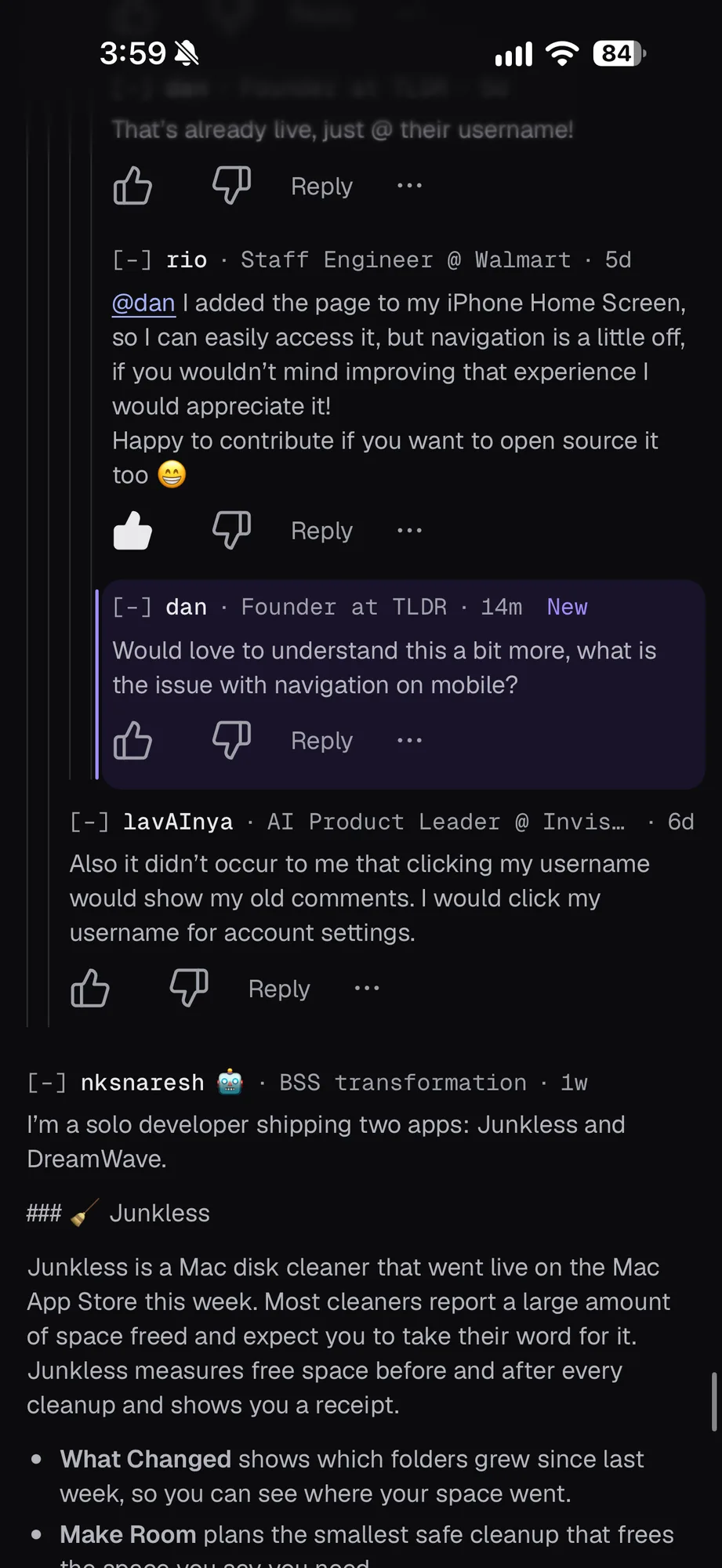
Here is an example of, when you add a page to your home screen you don’t get the browser look anymore… try it out, on an iPhone click on the share button on the page, then click on “add to home screen”.
There is no easy way to go back, once I click on a notification, I have to scroll all the way back up to see the top bar again, I have to scroll all the way back up to click on the logo to go back home… it is a weird UX…
I’m a solo developer shipping two apps: Junkless and DreamWave.
### 🧹 Junkless
Junkless is a Mac disk cleaner that went live on the Mac App Store this week. Most cleaners report a large amount of space freed and expect you to take their word for it. Junkless measures free space before and after every cleanup and shows you a receipt.
What Changed shows which folders grew since last week, so you can see where your space went.
Make Room plans the smallest safe cleanup that frees the space you say you need.
Everything goes to the Trash, so you can put it back.
Junkless cleans developer caches (Xcode DerivedData, old simulators, node_modules) without touching source or .git.
Junkless is sandboxed and runs on macOS 13+. Scanning and reviewing are free, as is the first 1 GB you remove. After that, it’s US$24.99/year.
🌐 https://mantravali.com/junkless/ · 💻 Mac App Store
### 🌙 DreamWave
DreamWave tracks sleep and snoring for people who don’t wear a watch. Leave your iPhone on the nightstand. It tracks your sleep and detects snoring on the phone itself, and you can play back the loudest moments in the morning.
v2.3.10 is live. You can now track without opening the app. Tap “Track tonight too” when you play a sleep sound or set the Smart Alarm, or use the “Start at Bedtime” Shortcuts action. Tracking begins once the phone has been still for 10 minutes.
The guided first week includes a Sound Check so you can hear the app catch a snore before your first night. You get a 7-night Snore Check and your Snore Type after three nights.
The Android version (native Kotlin/Compose) is in Google Play closed testing.
🌐 https://dreamwave.mantravali.com · 📱 App Store
The hardest problem so far has been that iOS won’t let an app start the microphone from the background. If you forgot to tap Start, you lost that night’s recording. Android allows a background start with one permission, so DreamWave can start by itself at bedtime on Android. Letting the versions behave a little differently has been an interesting product decision.
### Feedback and beta testing
If you try Junkless, tell me what it got wrong on your Mac. I’m collecting feedback for the first update.
If you have an Android phone, reply here to join the DreamWave beta. I still need testers to meet Google’s 12-tester requirement.
I believe software developers should follow the practice in aerospace and mechanical engineering of designing for failure before designing for performance. Engineers who build aircraft engines investigate not only whether an engine operates but also what happens when components fail, operating conditions change, or critical systems behave unexpectedly.
While building a payout verification layer, I’ve had to look beyond successful payout requests. How does the system behave if a payment provider times out, a worker crashes, or the same payout instruction is submitted twice?
Accounting for these scenarios is a fundamental engineering requirement for the product. A system should demonstrate both that it works under ideal conditions and how it behaves when conditions aren’t ideal.
How much of your engineering process do you dedicate to testing how your system fails?
Right now I'm working on this forum!
It's super early, so if anything feels clunky / broken please tell me! UX nitpicks, bug reports, etc. are all super useful.
Reply to this message and I'll prioritize fixes.