The $7,000 Box vs. the $300 Subscription
A GB10 box costs 19–28 months of frontier AI subscriptions but still can’t run the frontier models you’re paying for.
One thoughtful comment that is not AI-assisted unlocks the ability to create threads.
52 comments
This is kind of my thinking as well. I don’t believe all the Reddits and Medium posts about how local setups are “just as good” as the frontier models, not for one second. Having said that I also think it’s completely legit to create your own local setup for its own sake, even at thousands of dollar more than you’d pay for Claude Pro for a year.
In my long history of spending too much on tech, I’ve found buying stuff to figure out how it works and become comfortable with it has always been a good investment in myself.
I have a Mac M5 Max with 128GB and it's great. I also have access through my professional job to a Strix Halo 128GB, standalone GB10s with 128GB and a 4x GB10 cluster that we've been testing with some ~500b range models.
They are all great though the memory bandwidth on the Strix Halo and GB10s is painful. Especially if what you're after is vibe coding related, I don't think any of them (even the 4x cluster) are anywhere close to what Claude or Codex can do and I would make a guess that most people who justify the purchase of a $7k box by saying that they can then cancel their frontier subscription are going to be super disappointed and will ultimately resubscribe to the frontier service.
That said, this is where I think it will be very interesting over the next year or so with regards to hybrid environments. The available models that fit on a 128GB machine are quite capable for certain tasks (worker bees as @gsnook said) and given good tooling and smart routing, I think we'll see that while you might not be able to replace a frontier subscription with a 128GB machine, you might be able to get by with a cheaper frontier subscription with the local box handling the busy work.
I saw some Microsoft statement about hybrid Copilot where they think you can cut 20% of your frontier usage. I have no idea what the exact workloads were like that they based that on but it will be very interesting to see what people can come up with in open source harnesses to reliably increase that percentage.
I got the same hardware after thinking a lot. M5 Max Mac Studios being versatile, quiet was a big draw for me and if I'm not using local AI models, I can use it for other things like video editing, etc. I used the local models pretty successfully recently for the Muse Open Kernel Challenge and it's good enough for async tasks. I'm getting good tok/s with SSD offload too. Have I canceled my frontier subscriptions? No. I still find using latest models + offload still effective. I'm not using API prices yet for personal use, so that's good.
Just got a delivery today of the rtx spark surface dev box. It's... interesting. But on the plus side it's super quiet and doesn't give me any of the scary coil whine noises I get from my MacBooks (my m5 max 128GB is a 16" MBP).
And yeah... not using API pricing yet either for personal. If/when there's a price reckoning I may need to actually stop my frontier subs.
I chose the $6000 option to have access to models and hardened it a bit further. I wrote it up with some benchmarks here https://nextdoorhacker.com/2026/11/24/a-private-ai-workstation-on-a-mac-studio/
Hybrid is where I think it's at. My OpenClaw setup has a series of local models to do data enrichment, TTS / STT for when I talk to it via Telegram, t then uses OpenAI for its Chief of Staff and DeepSeek for the rest of the agents.
To some points made earlier in the thread this is also about learning what works well, what are the right tradeoffs to make when creating the architecture.
I invested in a $2700 Strix Halo mini-pc and found it useful enough to buy a second. I agree there is no replacement for the frontier model capabilities, but I like that I can iterate with the local models for 'free' (minus investment) and offload work to them 24/7. I have found that if a frontier model builds a robust, well-defined plan a local model can implement and test against the defined exit criteria with good results. The token savings is substantial and iteration time is free. Based on my token use at home, the mini-pcs have already paid for themselves in what I would have spent in the cloud.
That being said, I think the newer 192GB Gorgon Halo boxes at $6000 are not worth investing in at this time.
Do you have split between what you use local models for vs what you use frontier models for? Or is the boundary much more porous/interchangeable?
I've been doing various experiments in the game development space to try different splits, but I've seen good success with using the local models for research and ideation, gathering information and helping me refine an idea. Then, all that research is passed to a frontier model to craft a detailed implementation plan. It breaks down the plan into discrete phases each with clear, testable outcomes. The I use the local models to implement each phase in sequence according to that plan. 'Phases' are loosely defined as units of work that can be fully measured & tested and fit well within the local models' context window.
Local models iterate with me on research and data gathering (no need to pay the cloud for this)
Frontier models builds a robust plan and exact implementation steps. (let the big brain do the thinking)
Local models implement plan exactly as defined by the frontier model. (worker bees get the job done)
Interesting, what is the advantage or edge local models have on research? Just the cost or is it that your local model has "alpha" that a frontier model does not have?
Just cost savings. This is the "What if..." exploration stage: refining an idea, gathering research, maybe some competitive analysis. Very open ended, so I prefer to do that without cloud fees. At my last tech position (I'm available for hire, btw) I would use a lighter-weight model like Sol for this work to keep costs in check until the idea was refined enough to warrant engaging something larger and more expensive.
Keeping your data in house is often a requirement, especially in anything dealing with PII. Since I run a financing company we have lots of PII and things we can't send through the frontier companies without paying their enterprise API rates. So... for quite a lot of my workloads I don't have the option of a $300 subscription because the only way they give the legal terms I need is an enterprise agreement that is usage based and would end up costing me shit tons more. This is why I have 5 dgx sparks in my server room running various models for various reasons. My people don't have to worry about what they put into it because it never leaves the building :-)
I have built a server with 256Gb of DDR4 3200 RAM (faster than consumer DDR5 because it's 8 channel) and 72Gb VRAM (four GPUs).
It is much more capable than a GB10 and cost me a LOT less than $7K. I now only need a $20 Claude plan. Opus 5.5 does the planning, orchestration and validation. My rig does the grunt work. I never hit limits.
One of the best parts is that I can do image, video and audio generation on it as well as running some serious models (currently DeepSeek v4.1-flash 1017, GLM 5.3-flash, Qwen3.8-flash-next and inkling-mini).
The main thing is that I can now use AI for analysis of sensitive data entirely in a sandbox on my machine with no risk of it going to the cloud.
And I gain a lot of comfort from knowing that if for any geopolitical reason I lost access to American frontier models I would be completely self-sufficient.
I live in an SF bubble, is losing access to American models a common concern outside of the US?
Absolutely. It’s happened once already when Trump temporarily blocked Fable for all foreigners, even in the U.S.
I would not put it past him to use access to models as leverage over allies to influence policy, trade or even democratic process. In fact I fully expect it. Access to tech and oil has been used in this way historically so why not arguably the most important resource in the world right now?
It's been touched on slightly but the $7000 box gives you privacy no $300 subscription can really provide. IMO the value compounds further when you ask the question of if you need the frontier models. I've replaced Google Home entirely, for example, using a 9B Qwen model running on a 3080, and even at that size it's more than capable enough for that agent's requirements.
So as someone who values privacy and is comfortable selecting the right model for a given task, I'd favour owning the hardware long term any day.
I have a Dell ProMax GB10 (bought it when it was $4000) and also have pro subscriptions to Claude and Codex. I primarily use the GB10 for experiments on LLMs and CUDA related work. It is more to learn about GPU and LLM architecture / serving as opposed to actually running a model. For example I set up a K3ds setup with 3 copies of Qwen 0.6B model with llmd and Agentgateway. Goal was to evaluate Agentgateway and its End Point Picker integration.
I built a 2x7900XT workstation on the cheap by waiting for deals and can get ~80-90 tok/s on the new daisyrose Qwen 3.8 27b variant.
It's really surprising how well it can do, especially with plans from the frontier cloud models.
I know it's not as efficient $-wise, but:
I would've bought the hardware anyway because having computers like this is a hobby already for me
I really value the 100% privacy for some projects
It's hard to describe how liberating it is to not worry about "spend per token" for certain tasks
Having essentially unlimited tokens for some projects really helps me stretch how much I get out of the cloud subscriptions
If you look at it purely from a money stand point I don't think it is accurate to say it takes 19-28 months to earn it back. That completely ignores that that box has some residual value. You can sell it after a year and get a good bit of your money back. Even more so, on a setup like that your token speed should be pretty decent. There is no reason to use it for only one person. If you share it with your office or friends or whoever you like, it becomes 1 box vs N subscriptions, earning that investment back way faster. You also have no rate limits (looking at you Claude), which can be a huge deal if you use a lot of tokens.
Even more so, I think going for your own setup usually has some different motivations than just being able to run the best models. A box like that can still not run the frontier models, true, but with 128gb and some quantising you are getting some serious quality already, likely to keep improving as well. If your main requirement is performance and ease of use, big providers win hands down, so then it is not worth the investment and setup.
That's a good point, a better apples to apples comparison would be API costs vs cost of leasing and running hardware.
FWIW Revolut did move all their engineers to self hosted GLM-5.3 (x.com) and apparently did save a ton of money!
As far as I'm concerned, there isn't an open sourced model that can do what Anthropic's can. Call me an ANT Maxi, but IMO OpenAI isn't even close to Opus, Fable, Mythos. Open Source isn't close. UNLESS you have F@*k You money, to play around with, in the back of my mind, I will always wonder if I am getting the best code. I have multiple Subs, completely worth it. Other side of the coin here, I am building local models, ones that make sense and fit on Macs with 32-64gig as a side project for people who want them to do basic coding tasks etc however, IMO buying a $7K box doesn't make sense, it'll be outdated in 4-6 months as quickly as the models are showing up, getting bigger and bigger each release.
Agreed. I have a loaded 2025 M4 Max $4500 128GB Mac Studio and I run two locals. But it's also my dev machine so often times the cores are all busy so I have to manage and queue releases for the pipeline and other tasks for my workflow. I cannot imagine paying $20-$50k for a machine that will be out of date in 2-3 years just to run shatty OSS models. Frontier models are the way for serious development.
I'm genuinely interested in how you measure this. I have used Claude Code exclusively (ultra plan only, so in Claude Code itself) and Opus or Fable (don't have mythos) neither of those are as impressive as you state. I recently did a run on fable trying to optimize my tests and QA CI and it didn't do much of anything impressive if I didn't tell it that's what I wanted. So when someone says 'nothing is close' what are you measuring? I can run Sonnet all day and get code results, Opus almost makes it worse instead of doing something I ask it'll instead of reading the API and using it, it'll start to decompile the application instead, I can give it the entire API doc and state it has to use it and it'll literally think itself into 'eh, I can do it faster' and then grab the binary and start to decompile it.
My request was something like 'here is the API for application. Create a script that pulls <information> and puts it into a json file' and instead of reading the API docs, or following it, it immediately went to decompile (about two weeks ago, Opus 5.5)
Yet if I give that to Qwen 3.8 or something on a Mac Studio it just does it.
So what do you use Fable or Opus for that gives you something spectacular? All I seem to get is argued with or 'I can do it better' type results recently
Currently using Inklings new Mini model and also have modded Arete 3.8-27B. My Aris Server runs coding models on your Mac and serves them to Claude Code, Aris Code or anything that talks to Anthropic's API. Ollama is a general model runner, Aris Server does one job: hours-long coding-agent sessions that don't break. Its prompt cache is built for how agents actually work, compactions, rewritten prompts and long tool calls, so they keep going without re-reading their history. It streams every token, and guards against the ways local models stall and loop. One command and you're up and running. Still doing some testing that will run most of tonight and should be ready tomorrow morning(I'm in Az.)
Let me know how Inkling Mini works for you. (Genuinely curious). I've personally found Qwen 3.8 27B to still work better, as you can see from my not-so levelheaded crash out on huggingface. https://huggingface.co/thinkingmachines/Inkling-2-Mini/discussions/19#6b061788b3a607592e20211e
Oh man, I just read your HF post, funny. In Aris Code you can use either Inkling or my version of Arete 3.8- 27B which is better than the standard Qwen version, so there's that.
"Arete 3.8- 27B" I hadn't seen this yet! Thanks for mentioning. I finetune tons of models on Qwen so maybe I'll switch them over to this.
I have been working on local models for 6 months, on and off, I finally achieved what I have been working towards, I would be super appreciative if you checked out the model I modded and gave me some honest feedback. I am awake and having coffee, so I'll get back at it and hit you up when I am finished, everything is uploaded for y'all.
It's 130am here and I just finished testing. I was able to get 45tok/s on my M4 Pro 48GB. I'll have the full process of what needs to be downloaded later this morning. Inkling performs better for my setup, so Aris Code stripped of all T3 code things, My Aris Server(No Ollama, etc.) and then Inkling. Aris Server blows Ollama and the others out of the water. Also, yes, you don't have to use Aris Code either although it's highly recommended. IMO it's better than Claude Code Desktop. Next will be looking at Ternary Bonsai 2.5 27B... VERY curious about this one... I am hoping to get better speed, everything else is a Cherry on Top!
Some of our solutions need model stability and so are at the stage where I want a stable model that’s not going to be deprecated in 18months. I need both Frontier and familiarity!
I'm currently working with a Garden Centre / Distribution company; they were quoted 5-figure annual costs for implementing an AI-based solution. They currently pay £200/month for Claude, which is definitely beneficial for them, but extending their AI implementation is limited - what they currently do consumes their monthly tokens. We're looking at local installation to match their current use, but also to apply AI-based solutions to more processes.
I tried a smaller version of this, connecting 3 MacBook Airs for a total of 96GB RAM via Hex and Thunderbolt. It worked, but again, it didn't match the usefulness of the frontier-hosted models (obviously). But, if I can lease two or more Studios and get over 256-512MB of RAM, I'd love to see what happens :)
It all, as always, depends on use case and user requirements. With current pricing and for what I do, the decision is simple - subscriptions to Claude ($200) and Codex ($100) and Gemini thru cheap Google One. I have access to full list of LLMs from expensive to very cheap/fast and still can run local models for something like super fast log parsing on my Mac or Linux.
I'd think that very many benefit by running local workers on relatively cheap hardware and cloud based smart "architect/design/PM" running and assigning work to those workers. That is why we see many companies are offering similar services thru smart routing and similar ideas. I am sure all major ai companies will have something similar built into their harnesses (some functions are already there) to keep users in their ecosystem and that will on cloud use case very attractive for very many, probably until we go back to memory and GPU/compute glut
I suspect there will be a tipping point where pretty smart local models can run nearly instantaneously on laptops.
When that happens, I think local models will really take off since frontier models' latency will always be bounded by the speed of your network the local models would have a latency advantage in addition to a cost advantage.
This is basically what happened with Jev (super fast + cheap was very compelling as a value prop even though it's not as smart)!
yep, i do think that in few years will be no service and no HW devices without some sort of local AI built-in, but that would be very specialized AI or general use AI (chats for questions like "where is that email where Auntie sharing her turkey recipie ?"), and if you look thru the history, it is always goes in cycles from central compute with dumber local devices to very smart and powerful local doing a lot of stuff locally and center/cloud is doing mostly the same with huge scale and redundancy (in theory at least)
Yup, but it can run smaller models that are more than capable of doing a lot of work. Frontier models are great for some tasks, but you don't need them for everything.
It can also run models privately. Which is helpful if you are dealing with confidential data.
It can also run unrestricted models if you have use cases for these.
Different tools for different jobs
Saw this thread on X that was a quick survey of opinions on running local models vs frontier models. It seems like it's not an exclusive decision. Both have different purposes in the market. May be a good parallel is how we have different purposes and styles of communication for forums vs social media vs talking in a group chat https://x.com/emilylai/status/2124588757999300778?s=20
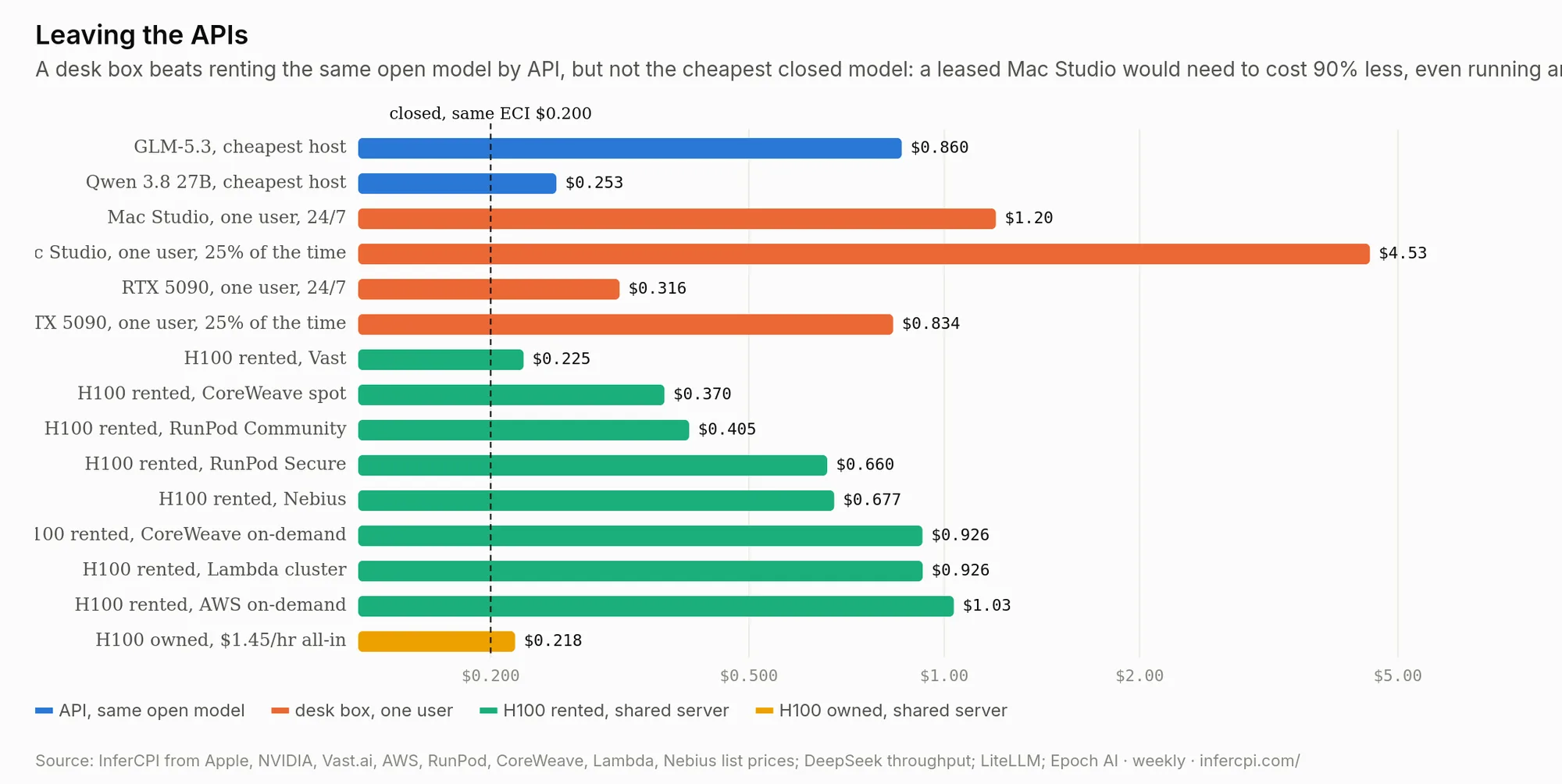
Privacy and autonomy are the the only reasons to run a local model until economics shift, and you can't put a price on that. Ignoring lack of stable internet, tinkering, and other deployment requirements. https://infercpi.com/#leak
The 19–28 month comparison should probably include resale value too. That doesn’t close the performance gap, but the $7k box is still worth something after two years.
A $5,600–$8,500 "personal AI supercomputer" costs as much as 19–28 months of a $300/month power-user AI stack. It adds to the cost rather than replacing the stack. It runs one open-weight model at a time. On Artificial Analysis's index, the best model that fits on the box scored less than a quarter as high as a frontier model.
If all you want is tokens then don't buy hardware. If you're calculating your ROI on token generation then don't buy hardware.
If you want to learn how the systems work, own your critical infrastructure, or like to experiment then buy hardware.
I bought $10,000 in hardware because I fall in the second camp and knew I would pay at least $5,000 for a training course to get hands on with these systems. Instead, I bought it all myself and have learned a lot over the past 6 months. I've learned so much I'm going through interviews for new roles that will pay 2x for the skills I've learned. My ROI calculation goes much further than tokens.