Introducing Gemini 4 Neon
Google’s Gemini 4 Neon tops the WebExploitBench v1.2 penetration-testing benchmark at half the cost of competing large models.
One thoughtful comment that is not AI-assisted unlocks the ability to create threads.
33 comments
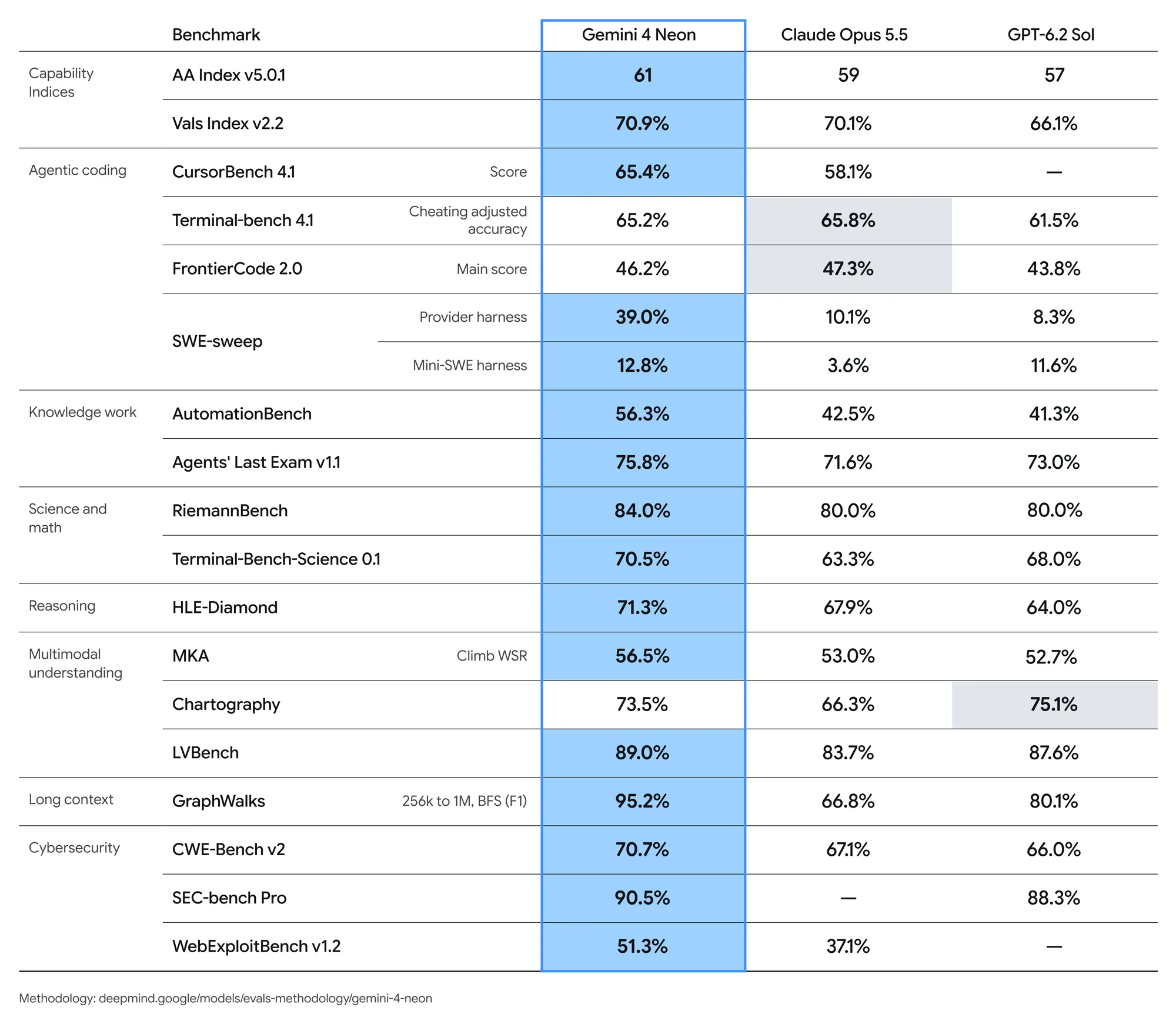
Somehow DeepMind went from shipping nothing but flash models for almost a year to big model releases every week.
This is a smaller model than Carbon but beats Carbon on AA Index (it has an xhigh thinking level where Carbon only goes up to high), priced $3/M input tokens and $15/M output tokens, doesn't have the 50% off discount so Carbon is actually cheaper through the end of November.
After a bit of testing it feels a lot more benchmaxxed than Carbon unfortunately, it's much slower and more expensive (like 3-5x slower and more expensive) than GPT-6.2 Sol and roughly the same quality on a couple of our internal evals like summarization and visual slide deck QA.
Neon is an impressive model. It ranks 3rd on the AAI index, which is quite a hard benchmark. The fact that it performs better than Carbon shows a continuing trend among top labs where the adapted model usually outperforms the base model across all major benchmarks.
I (biasedly) enjoy all the Gemini models, especially because their outputs feel distinctly different from Claude/GPT models. My honest thoughts though are that Hydrogen is so fast and smart that it still is better as a daily driver next to Opus 5.5, and Carbon/Fable are best used for tough/longer-running tasks that require a lot of thinking.
Do you use it for coding? Are you using it with Antigravity? My problem is that Gemini as a model might be great but Claude Code as a harness is just perfect. Hard to catch up.
I've been using Gemini through Vercel's Eve harness but I think a lot of people really like Gemini in Pi!
@nate uses Antigravity I believe, I think the Antigravity team is shipping a lot faster nowadays.
I use the Antigravity CLI but no other Antigravity products. Unfortunately, the CLI has been almost unusably buggy for about a month now. There's a chance that "buggy" is not the right word or that there's some sort of subagent configuration I'm missing, but it often happens that it takes over 10x as long to do a simple task as any other CLI tool would. It's bad enough that I went down to the lowest subscription tier because there's so rarely a reason to use it.
I actually saw a lot of people complain about this, but I read this article that actually blames the models: https://kernel.dev/blog/why-is-gemini-4-carbon-taking-so-long/
It seems like the new wave of Gemini models love to work. This has been my personal experience too so far.
I’m personally a big fan of Carbon’s personality and writing style I find myself defaulting to it quite often!
I am really confused by Google offering, I can't wrap my head around what is the difference between Argon, Carbon, Hydrogen and now Neon. What should I use and for what use case? Also the naming scheme does not immediately tell me which is the best or the cheapest model.
I have always been kinda a Google fanboi, so it's nice to see them cranking out top tier models.
I need to play with Neon, Carbon seemed to think forever. Does Neon solve that problem?
I did my first development sprint with Neon tonight in Anti-Gravity, and it passed my informal testing. I can't share exact specifics, but when I asked Claude, our Codex, to review its code, it said, "Pretty good," and then gave some standard adversarial feedback. Previously, before Neon and Carbon, it tore it apart and founds serious holes in almost everything Gemini produced but this time it is different.
Oh, I agree with another commenter that I like Gemini as an alternative to Claude & Codex, which seem to be more relatable to each other. I hope Google can keep up going forward and this is the last time it falls this far behind.
Neon might be “half the cost” on paper, but it uses so many tokens that I can’t use it as my daily driver on a Pro Google AI subscription. I run it in Antigravity, where it used up my 5-hour allowance in a little over an hour and consumed 30% of my weekly limit.
I have to use Hydrogen for routine work and reserve Neon strictly for heavy multi-file orchestration. Neon is an absolute work of art, and I especially enjoy using it on hard problems.
I thought they were doing the obvious thing and just saying, "Oh here's the name of an element. The higher you go on the periodic table, the better the model is." But now I have no idea what the naming scheme for Gemini 4 models actually correlates to.
My main issue with Gemini models in general is that Google is not exactly making it easy to use them for privacy-sensitive work.
Time to breakout Antigravity again. Are we in for another wave of tit-for-tat releases over the next few weeks?
Since the new naming Conventions for Gemini 4 aren't exactly intuitive and the odd fact that they made Argon obsolete within weeks, I let Hydrogen threw together a quick and dirty interactive comparison chart next to Claude models with pricing from Dec 1st, 2026 onwards. Enjoy: https://sites.google.com/view/like-a-g4/
I echo the confusion about the model naming and not an easy way to mentally switch the models depending on the task. I wish they could split the model names by "good for coding" and "good for building general-purpose agents".
Also a little worried this is a teaser price and might go up over time, erasing the cost efficiency when productionizing these.
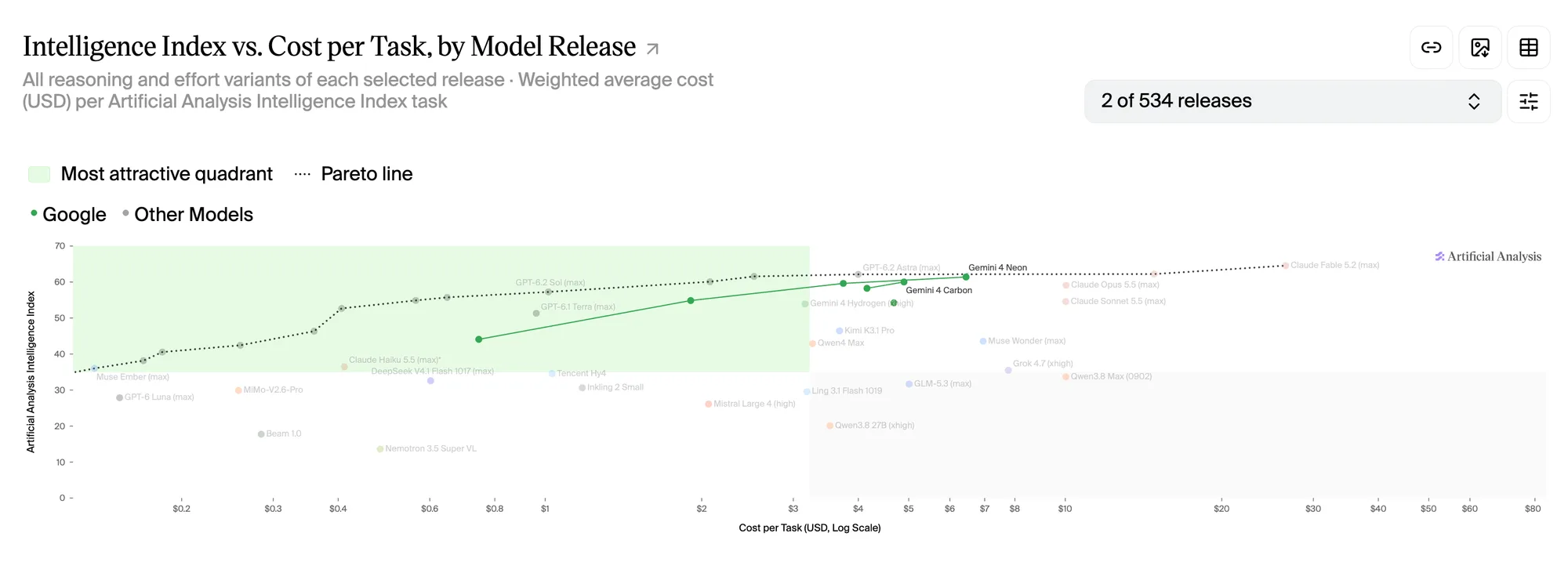
Everyone here is comparing Neon on summarization and tool calling. The line that caught my eye is the pentest benchmark: top of WebExploitBench at half the price.
I'm an information security officer and I run a small passive recon agent against public-sector websites in Poland. It checks the basics: certs, security.txt, plugin versions. Finding issues was never the hard part. Verifying them by hand was.
A cheap model that is good at exploitation lowers that cost for attackers first. Defenders get the same model, but someone still has to read the report and patch.
Has anyone pointed it at their own staging app yet?