Humans are more efficient learners than AI
Bullish on Human Intelligence — Jiaxin Wen
Humans are able to learn from many fewer examples than AI, by a margin that AI is not likely to surpass anytime soon.
Human-led research produced a reported 100x more learning than AI-led research, even when the AI’s solutions were understandable.
Pretraining and biology have expensive, slow verification, so human sample efficiency still matters more there than in math.
One thoughtful comment that is not AI-assisted unlocks the ability to create threads.
7 comments
It is clear that current architecture that are released by frontier labs are definitely not sample efficient , but I wonder if that will hold as the labs continue to push the frontier, there are several conceptual hurdles that in my opinion make sample efficiency with current approaches counter intuitive
RL in itself is not sample efficient, there is no cost for running multiple experiments, whereas biological evolution typically imposes a very high cost if you there is a failed experiment (injury or death).
Biological intelligence seems to learn at multiple timescales , from genations learning via evolutions as well as cultural/social cues and conventions to working memory learnt in seconds or minutes.
The ability to have internal representation of the world and reason about those representations allows humans and other biological brains to be highly sample efficient , its unclear if the current frontier models that are currently available can do that.
All of these areas are being actively researched and its unclear if there is any fundamental law that prevents us from solving them, other than they are hard ambiguous problems
#1 and #2 are really interesting, hadn't quite thought about that particular framing of RL vs biology. I'm not sure I agree on #3, it's not super clear to me that a world model or reasoning are what allow humans to be sample efficient, it actually seems like it could just be evolution training better priors? For example a newborn horse can walk right away whereas it takes RL a really long time to learn to walk by trial and error.
My interpretation of the article is that it's more a statement about whether we'll reach human level sample efficiency in the next few years.
But for human-level sample efficiency, assuming no slowdown or pause, I’m cautiously bearish on AI reaching it by 2030.
I think the interesting thing about sample efficiency in particular is that unlike progress in other capabilities, naive extrapolation of the trend doesn't get us to superhuman levels that soon.
Furthering the idea that hard to verify domains are better for humans, I think we underestimate how much of our world is "hard to verify". Imagine a business run with modern agents. They would endlessly experiment on products, pricing, distribution. They would do market research surveys and determine the best product/price positioning. Uncharitably, this is what MBA's do in large corporations. You can easily see the negative effects those corporations have on product quality and customer satisfaction.
A human will come along and say, that isn't right, and simply do it differently mostly based on conviction and gut feeling. There is a reason why small businesses make up 43.5% of the GDP of the US. The needs of small areas and different fields is so niche that you need to be able to have a conversation with a few friends in the field and make an intuitive leap to what the "right" answer is.
I'm confident an LLM could do this today, but the result would be a deluge of crappy products until they found something "correct". The end consumer is, currently, still a person. Anyone who works with LLMs can tell you that they don't really truly understand us.
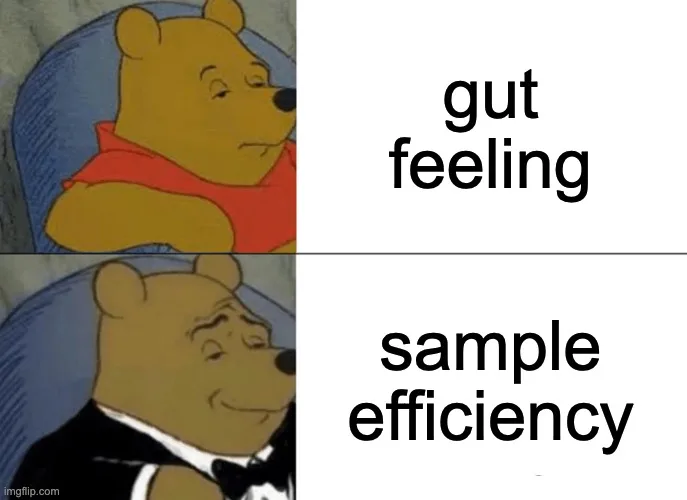
On one hand it's good that all the human capital that went to arbitraging inefficiencies you could find in a spreadsheet can now go find more productive things to do, on the other we probably don't actually want superhuman AI to be managing businesses via spreadsheet (essentially running every business like it's PE-owned).
I do think that truly product-led businesses would shine in this paradigm, product taste does seem to fit right in the middle of the "few data points + expensive to verify" Venn diagram.
Agreed. I am finding AI to be immensely helpful when learning and doing my research. But left to itself, AI can just start hallucinating in loops and pretty much produce some bloated nonsense.
With all the doom and gloom around AI surpassing humans in all domains imminently, it's important to remember that humans are still wildly more efficient at learning from each piece of data they see. In non-verifiable domains where you it's harder to train a model via RL, humans will likely still have an edge for the foreseeable future.